
Maximising The Blueprint: Smart Water & Hidden Yield
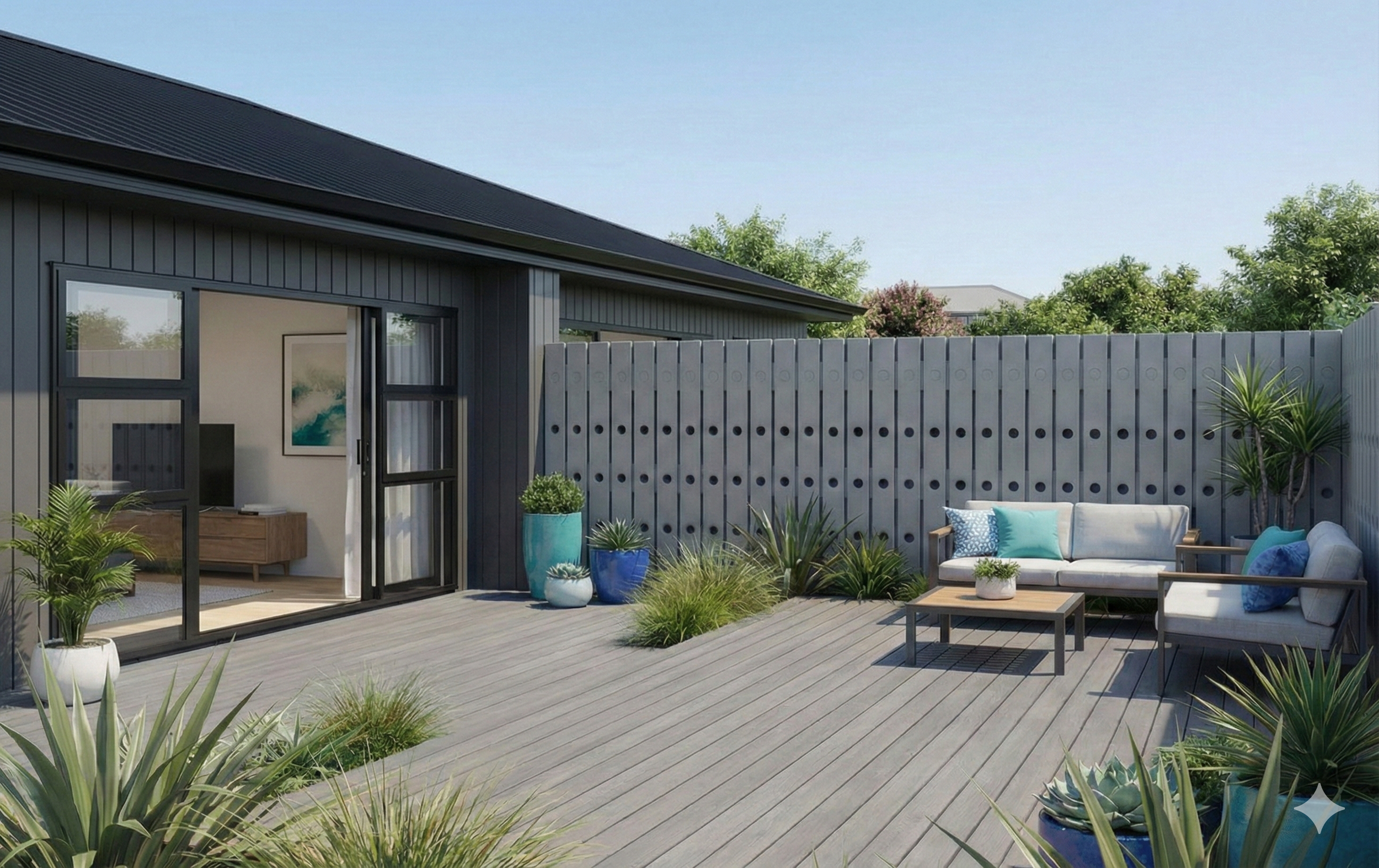
Pictured: Multiple 1000L FenceTanks connected in series
In New Zealand’s urban centres, square metre rates have reached a threshold where every centimetre of a site plan must justify its existence. For developers and specifiers, the pressure is two-fold: construction costs continue to climb (Stats NZ reporting a 3.6% increase in residential costs in the year to September 2024), while land availability remains at a premium.
In this high-stakes environment, water infrastructure shouldn't be a compliance tax that eats into your margins. Instead, smart developers are looking at water management as a spatial puzzle. By selecting the right technology for the specific constraints of a site, you can reclaim land, reduce civil complexity, and turn a utility into a commercial asset.
Beyond the Default: Moving from Cost Centre to Asset
Traditionally, stormwater management was an afterthought. A large concrete tank buried wherever there was room left over. While functional, these 'one-size-fits-all' systems can often impose unnecessary constraints on a modern, high-density development.
The shift today is toward Integrated Water Design. It’s about recognising that a site’s hidden yield is often locked away in the margins, the boundaries, or even under the driveway. The goal is to meet tightening council compliance without sterilising land or adding weeks to the construction programme.
Choosing the Right Tool for the Site
At Watersmart, we view water infrastructure through a commercial lens. Our carefully curated products are designed to give developers the flexibility to place water storage exactly where it makes the most financial sense.
1. Reclaiming the Boundary: FenceTank
When horizontal space is the primary bottleneck, moving water storage to the perimeter is a game-changer.
The Yield Win: By replacing a standard timber fence with the FenceTank, you reclaim the central site area. In medium-density projects, this can free up enough the Outdoor Living Area to satisfy council requirements for an additional unit or larger communal spaces.
Civil Savings: Because it sits above ground on the boundary, it eliminates the need for deep excavation, shoring, and dewatering, saving significant time in the early stages of a build.
2. The Integrated Foundation: Aquacomb
For sites where boundary space is tight but the footprint is large, the solution lies just beneath the surface.
Smart Sub-Surface Storage: Unlike traditional bulky concrete tanks that limit what you can do above them, Aquacomb is designed to integrate into the building’s slab or sit beneath driveways and lawns.
Zero Footprint: It allows developers to utilise the entire site area for construction or landscaping without losing land to a dedicated tank zone. It’s about high-capacity storage that stays completely out of the way of the saleable yield.
3. Precision Placement: Slim City
In ultra-dense urban infill projects, sometimes you only have a narrow side-yard or a small cavity beside a carpark.
Modularity: Slim City units are designed to fit into these otherwise typical dead zones. They are the ultimate plug and play solution for achieving hydraulic neutrality on complex, multi-unit sites where every millimetre counts.
Meeting Compliance with Design Certainty
Council regulations, particularly under the Medium Density Residential Standards (MDRS), now demand robust on-site detention and retention to protect aging municipal networks. This often leads to compliance creep, where water requirements grow as the design progresses.
By partnering with Watersmart early in the Design & Consult phase, developers gain access to specially engineered, predictable solutions. Whether it’s an above-ground FenceTank or an integrated Aquacomb system, our solutions provide:
Visible Compliance: Easy access for inspection and maintenance, which simplifies the council sign-off process.
Hydraulic Precision: Systems that are easy for engineers to model, ensuring no nasty surprises during the consenting phase.
Kaitiakitanga: Resilience as a Sales Differentiator
Beyond the numbers, there is the market. New Zealand buyers are increasingly looking for homes that reflect Kaitiakitanga (guardianship). A development that captures roof water for reuse in toilets and laundry isn't just eco-friendly; it's resilient.
A water-wise development is a more marketable one. Pointing to a FenceTank or a sophisticated Aquacomb system tells a buyer that the developer has invested in quality and long-term property protection. It turns a functional necessity into a tangible selling point that can increase sales velocity.
To Wrap It Up
Development is a game of margins and risk management. Choosing the wrong water solution can lead to expensive variations, lost land area, and delayed programmes. Shifting your perspective to integrated water design allows you to align hydraulic compliance with your commercial goals.
Whether your site demands the boundary-saving profile of a FenceTank or the hidden efficiency of Aquacomb, the objective remains the same: protecting the environment while securing your profit margins.
Sources
Stats NZ. (2024). Business price indexes: September 2024 quarter.
Ministry of Housing and Urban Development. (2023). Medium Density Residential Standards (MDRS).
Insurance Council of New Zealand. (2024). Climate Change and Insurance.