
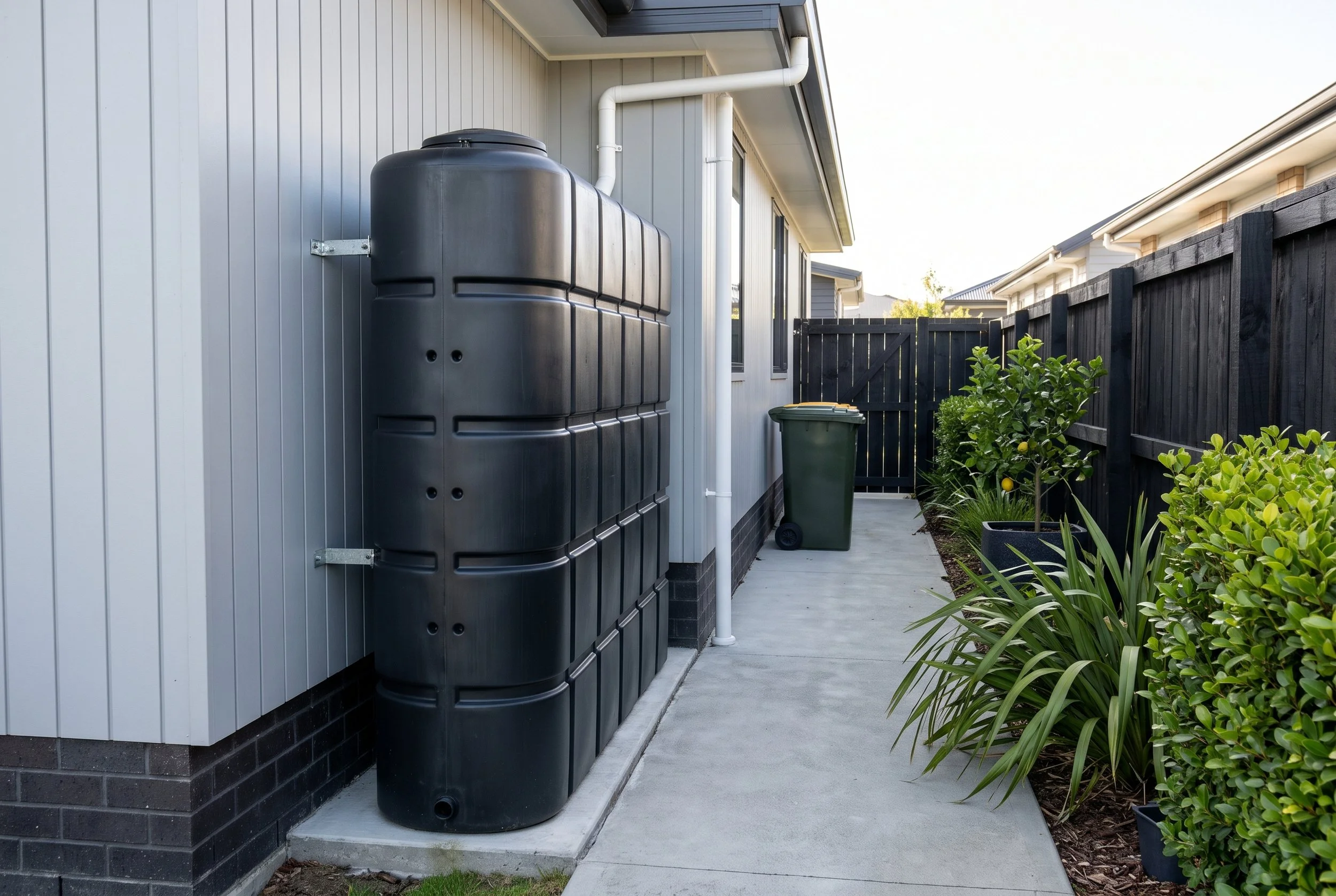
The right water tank for a New Zealand site comes down to four questions, asked in order: what the water is for, where the tank can go, how much it needs to hold, and how it will look. Purpose comes first because it shapes every other answer. A detention tank manages stormwater to meet council rules, a retention tank stores water for you to use, and many new builds need a combination of both.
Space usually settles the rest. Most new builds and infill sections have no room for a standard round tank, so the real choice is between a slimline tank above ground, along a fence or wall, and a modular tank hidden under the slab or driveway.
We covered the engineering side of this in The right tank solution to manage stormwater and rainwater in our crowded cities, including fall to the stormwater connection and how designers split roof and ground runoff. This guide works through the decision from the owner's and designer's side, then shows where each Watersmart tank fits.
What's the difference between a detention tank and a retention tank?
A stormwater detention tank holds runoff from roofs and paved areas during heavy rain and lets it out slowly through a small outlet, so downstream drains and waterways can moderate the flow. A retention tank stores roof water for use on the property.
Detention is usually a consent requirement. In Auckland, the Auckland Unitary Plan's SMAF rules (Stormwater Management Area: Flow) require new development in sensitive stream catchments to provide detention and retention, where part of the water is held back for reuse. Your engineer or designer sets the volume, and the tank has to deliver it. We explain why those rules exist in SMAF requirements.
Additional harvesting is a choice you make for your own reasons: a garden that stays green through a dry summer, lower water bills, or a reserve for when restrictions arrive.
Some sites need both, and one system can do both jobs. Aquacomb lets you split the volume between detention and reuse, so some of the water is released slowly as stormwater while the rest is stored for the toilets, laundry or garden.
Every Watersmart tank can be set up for detention, retention or a combination of both, so the choice of tank comes down to the site: where it can go, how much it needs to hold and how it will look.
Where can a water tank go on a small section?
On a tight site, placement narrows the options quickly. Here is where each tank is designed to go.
Along the fence line. FenceTank is a slimline rainwater tank that doubles as the fence. It is just 410mm deep, mounts to fence posts, and links in series to run along a boundary. Boundaries once raised a fire question for plastic tanks. In 2024, an MBIE determination found that a 5,000-litre plastic stormwater tank 150mm from a Henderson boundary was not a fire risk to the neighbouring property under Building Code clause C3.
Against the house or in a side yard. Slim City comes in 2,000L and 3,000L sizes. The 2,000L tank is 510mm deep, which leaves room to wheel a bin past, and the 3,000L is 750mm deep. StormPANEL is another slim tank option, 460mm deep, in 1,000L and 2,000L sizes that connect together. It installs on a concrete base at least 100mm thick.
Somewhere to start small. Silo is an 800L plastic rainwater tank, 770mm across and 1,970mm high, and more tanks join on as your needs grow.
Under the slab, driveway or deck. Aquacomb is New Zealand's first in-slab stormwater detention and retention system in pre-packaged kit form. Its pods are 1,100mm square and only 225mm or 300mm deep, so they fit under a driveway, patio, deck or the house slab itself. A system under a slab or driveway is hard to reach, so Building Code clause B2 requires it to last at least 50 years.
Underground, for deeper storage. StormVAULT is an underground detention tank engineered for varied NZ soil types and water-table conditions, including beachfront and hillside sites. It comes in sizes from 2,000L to 10,000L, and tanks can link together for larger volumes.
Wherever it goes, the tank also has to sit high enough for water to drain from it to the stormwater connection. Our earlier article covers how designers handle that fall.
How much water does the tank need to hold?
For detention, you don't pick the volume. The engineer calculates it from the site's hard surfaces and the council's rules, and the tank has to meet that figure.
For voluntary harvesting, the volume depends on roof area, local rainfall and what you want the water for. One millimetre of rain falling on one square metre of roof is one litre of water. A 150m² roof in a 20mm downpour collects up to about 3,000 litres, enough to fill a 3,000L Slim City in a single storm.
Most Watersmart tanks scale, so storage can grow with the site:
FenceTank units link in series along a boundary.
Silo tanks can be joined together.
StormPANEL and StormVAULT tanks connect for more volume.
Aquacomb systems typically range from 3,000L to 30,000L.
We go deeper into sizing, including how much water a household actually uses, in our guide to what size water tank you need.
How will the tank look?
On a small section, the tank becomes part of the view, so looks matter.
FenceTank replaces a section of fence instead of a separate tank standing in front of one. At a Forrest Hill home, we removed about 14 metres of old fencing and replaced it with interconnected FenceTanks, adding storage without giving up any outdoor space.
Standalone Slim City tanks come in a range of colours to seamlessly integrate within the surroundings of your property.
Aquacomb disappears once the slab or driveway goes over it. At Cottonwood Lane in Woodridge, in-slab detention kept the home's wide valley views clear of any tank.
Which Watersmart tank suits which site?
Narrow boundary, no spare yard: FenceTank, which doubles as the fence.
Side yard or wall, 2,000L to 3,000L needed: Slim City, slim enough to leave a path.
Tight space on a development: StormPANEL, 460mm deep, 1,000L or 2,000L per tank.
Starting small, room to add more: Silo, 800L tanks that join together.
No space above ground: Aquacomb, hidden under the slab or driveway.
Larger volume, stored underground: StormVAULT, deeper storage with tanks that link together.
Any of these can be set up for detention, retention or both. The tanks are also designed to work together. A site might run Aquacomb under the driveway for detention and a FenceTank along the boundary for garden water. Add a RainSaver pump to deliver stored water to toilets, laundry and garden taps at proper pressure, and a Leaf Diverter on the downpipe to keep leaves and debris out of the tank.
Frequently asked questions
Do I need a detention tank for a new build?
It depends on your council and your site. In Auckland, new developments in SMAF areas must provide stormwater detention and retention under the Auckland Unitary Plan. Your building consent will state whether a detention tank is required and what volume it must hold.
Can one tank handle stormwater detention and rainwater harvesting?
Yes. Every Watersmart tank can be set up for detention, retention or both. Aquacomb does both in one connected system: the height of the orifice in its AquaPit sets how much of the volume is detention and how much is kept for reuse, so one installation meets the council's detention requirement and stores water for the house and garden.
What water tank fits a narrow side yard?
A slimline tank. FenceTank is just 410mm deep and mounts on fence posts, StormPANEL is 460mm deep, and the 2,000L Slim City is 510mm deep, which leaves room to wheel a bin past it.
Can a water tank go under a driveway?
Yes. Aquacomb pods are 225mm or 300mm deep and are designed to sit under driveways, patios, decks, lawns and slabs. Because a tank under a driveway is hard to reach, Building Code clause B2 requires it to have a service life of at least 50 years.
How do I use rainwater from a tank inside the house?
You need a pump. Our RainSaver Pump delivers stored rainwater to toilets, laundry and garden taps at proper pressure, and it works with FenceTank, Slim City, Silo and Aquacomb.
Not sure which tank fits your site? Call the Watersmart team on 0800 11 08 08 or discuss your project with us, and we'll help you match the tank to the job.