
The Role of On-Demand Flood Infrastructure - Building Tomorrow's Resilient Cities
When Cyclone Gabrielle tore through the North Island in February 2023, it left behind $14.6 billion in damages and a hard question for every council, developer, and property owner in Aotearoa: what are we actually doing to prepare for the next one?
The honest answer, for most of us, was not enough.
New Zealand sits in a uniquely exposed position. Our cities sprawl across floodplains. Our stormwater networks were designed for rainfall patterns that no longer exist. And our go-to flood response, the humble sandbag, hasn't meaningfully changed since World War I.
That gap between the floods we're getting and the infrastructure we have to deal with them is where on-demand flood protection fits. Not as a replacement for permanent infrastructure, but as the missing layer between "we should do something" and "it's already raining."
The Problem With How We Think About Flood Protection
Most flood mitigation falls into two categories:
permanent and reactive.
Permanent solutions, stopbanks, flood walls, detention basins, are the right choice for many situations. They protect critical infrastructure, high-risk zones, and properties with consistent, predictable flood exposure. But they're not suited to every scenario. Some sites don't have the space. Some flood risks are intermittent or directional. Some properties need protection now, not in 18 months when a construction project wraps up.
On the other end, reactive solutions, sandbags, mostly, are cheap but brutal. A single sandbag weighs 15-20kg when filled. Protecting one standard garage door takes roughly 40 of them. That's 600-800kg of sand that someone has to source, fill, stack, and later dispose of.
What's been missing is something that fills the gap: portable, fast to deploy, reusable protection for the scenarios where permanent barriers aren't practical and sandbags aren't good enough.
What On-Demand Flood Infrastructure Actually Looks Like
The concept is straightforward. Instead of building permanent barriers everywhere, or scrambling for sandbags when warnings go out (unreliable), you pre-position lightweight, modular barriers that can be deployed in minutes by one person.
This is what Floody was designed to do.
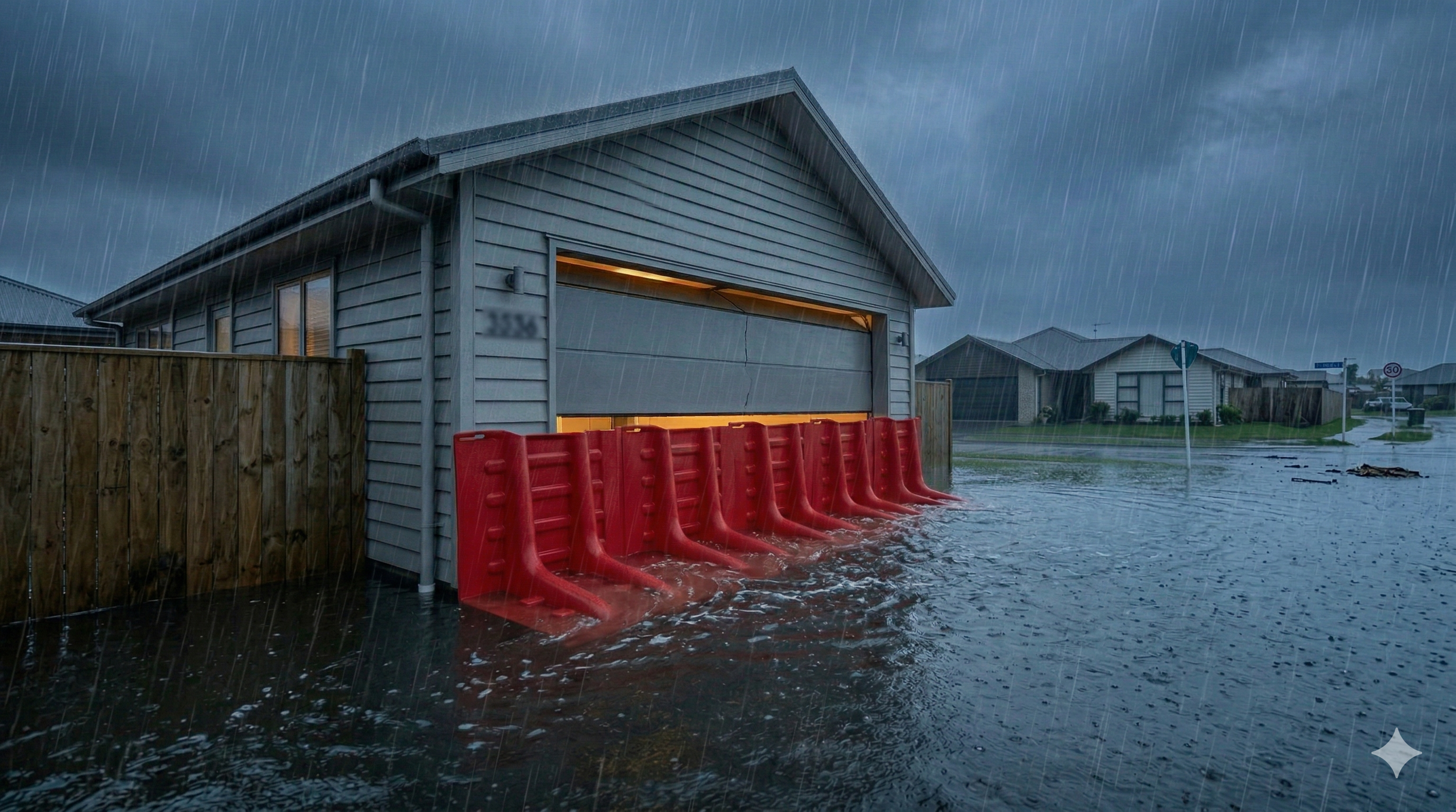
Floody is a portable flood barrier system that a single adult can install at a rate of 10 metres per minute. No drilling, no tools, no sand. Each module locks into the next with a simple mechanism, and the barrier uses the weight of rising water to anchor itself to the ground. A foam gasket along the base creates a seal against flat surfaces like concrete and asphalt.
When the water recedes, the modules stack flat for storage. They're light enough to carry by hand.
It sounds simple because it is. But simplicity is exactly what's needed when someone has 30 minutes' warning and water coming from a direction nobody predicted.
Three Configurations for Different Scenarios
Floody isn't one product, it's three, each designed for a different exposure:
Garage door protection — The most common residential flood entry point. Floody's garage configuration creates a sealed barrier across standard and double garage openings without any permanent fixtures or modifications to the door.
Perimeter barriers — For properties exposed on multiple sides, modular sections connect to create longer runs around buildings, driveways, or outdoor areas. The system handles straight lines and angles.
Doorway and access point barriers — Smaller modules sized for pedestrian doors, French doors, and other openings where water typically enters.
Each configuration draws from the same modular system, which means a property owner can protect a garage today and extend coverage to other entry points later without replacing anything.
Why This Matters for Urban Development in New Zealand
Here's where flood protection intersects with a problem most New Zealanders don't think about until resource consent time: stormwater compliance.
Every new development in New Zealand needs to demonstrate how it will manage stormwater. Councils across Auckland, Wellington, Christchurch, and the regions are tightening requirements, partly because of climate projections, partly because existing networks are already at capacity.
For developers and architects working on medium-density housing (which is most new residential construction under the MDRS), flood risk adds a layer of complexity. Sites are smaller. Setbacks are tighter. There's less permeable ground to absorb rainfall, and less room for traditional detention solutions.
On-demand barriers like Floody work alongside detention and retention systems (Watersmart's Aquacomb handles that side) and complement permanent flood barriers like Flood Free, adding a deployable protection layer for properties and scenarios where a fixed installation isn't the right fit.
For councils evaluating resilience across their networks, portable barriers offer something permanent infrastructure can't: flexibility. They can be deployed where they're needed, when they're needed, and redeployed somewhere else next time.
The Insurance Angle
After the 2023 Auckland Anniversary floods and Cyclone Gabrielle, insurers reported over 90,000 claims. Some have since adjusted premiums in flood-prone areas. Others have reduced coverage outright.
For property owners, demonstrating documented flood mitigation measures moves the conversation from "unprotected exposure" to "managed risk." Floody's reusable, storable design fits this, it's not a one-time emergency purchase, it's part of an ongoing property protection strategy.
Being Ready, Not Just Equipped
Owning a flood barrier is one thing. Being ready to use it is another. The failure mode for most flood preparation isn't the equipment, it's the plan.
Know your flood exposure. Which direction does water come from? What's the lowest entry point? A conversation with Watersmart's design team helps figure this out.
Store barriers accessibly. Not in a locked container at the back of the property, somewhere you can reach at 3am.
Practice deployment. Run through the setup once before it's raining.
Maintain the equipment. Check gaskets annually. Replace anything damaged. Flood barriers are only as good as their readiness on the day.
Where Portable Barriers Sit in a Broader Resilience Strategy
No single product solves flooding. Anyone who tells you otherwise is selling something that won't work.
Genuine urban flood resilience requires layers:
Network-level infrastructure — council stormwater upgrades, detention basins, improved pipe capacity.
Site-level water management — on-site detention (like Aquacomb), permeable surfaces (like Porous Lane), rainwater harvesting.
Property-level protection — portable barriers, raised floor levels, backflow prevention valves.
Community-level preparedness — warning systems, evacuation routes, neighbourhood response plans.
Floody operates at layer three. It's the protection a property owner controls directly, independent of whether the council has upgraded their pipes or the neighbour has sorted their drainage.
That independence matters. In a flood event, you can't control what happens upstream. You can control whether your garage door has a barrier in front of it.
The Shift From Reactive to Ready
New Zealand's relationship with flooding is changing, not because we want it to, but because the weather is forcing the conversation.
The cities that handle this well won't be the ones that build the biggest stopbanks. They'll be the ones that layer permanent infrastructure with flexible, deployable protection that individual property owners can actually use.
That shift, from reactive scrambling to pre-positioned readiness, is what on-demand flood infrastructure represents. It's not glamorous. But when water is coming through your garage at 2am, it's the difference between damage and no damage.
Floody was built for that moment.
Ready to assess your property's flood exposure? Talk to the Watersmart team about a design consultation, they'll help you figure out what protection makes sense for your site, your budget, and your risk profile.
Watersmart is a New Zealand water management company providing end-to-end solutions across detention, treatment, monitoring, and flood protection. Learn more at watersmart.co.nz.
