
El Niño in New Zealand: Why Two Regions Face Opposite Water Problems
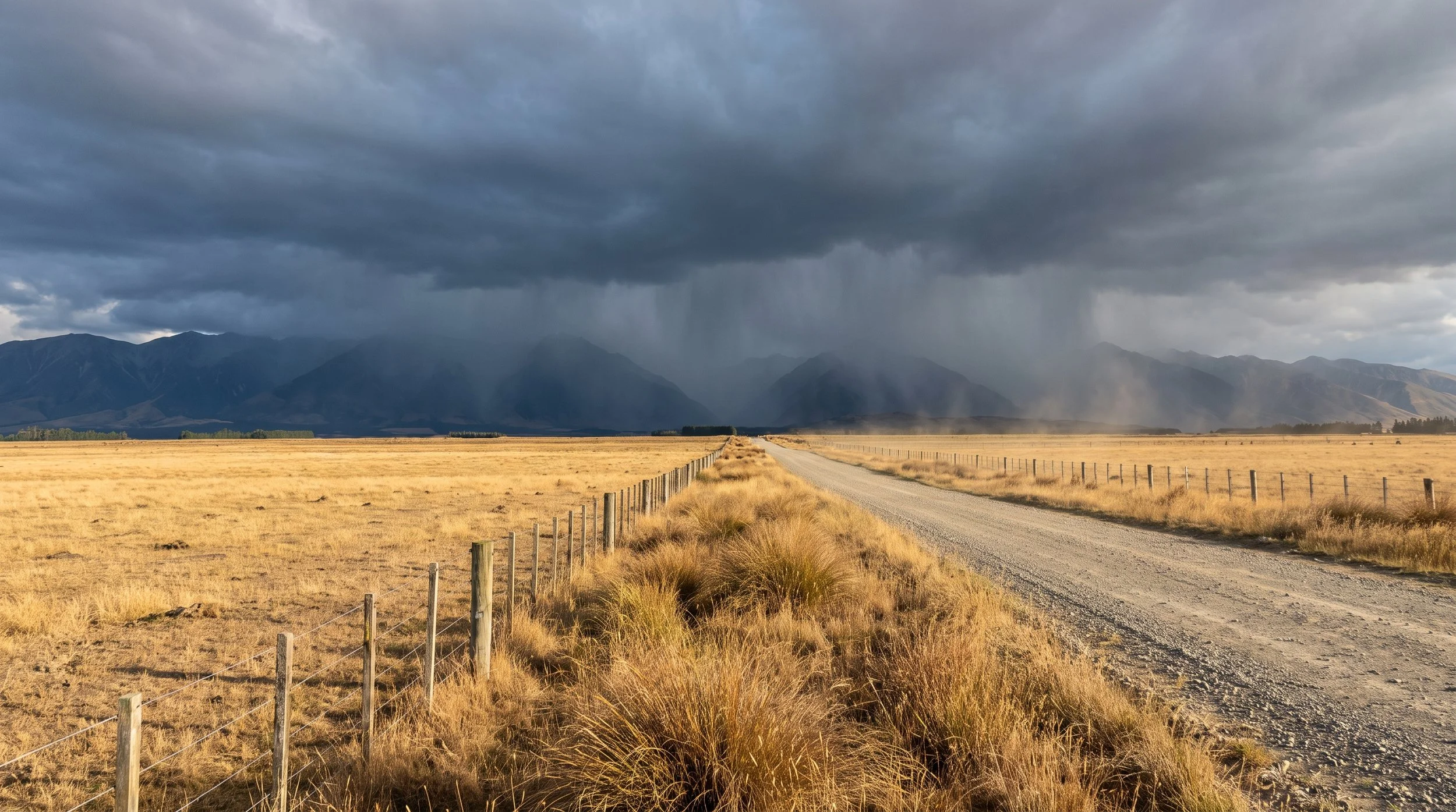
NIWA has declared a strong El Niño weather pattern and expects it to peak over the 2026–27 summer, with a chance of ranking among the strongest on record. The common assumption is that this means a dry summer for New Zealand. That is only half right, and the half that gets missed causes the more expensive surprises.
El Niño does not remove rain from the country. It moves it. The pattern strengthens westerly winds across New Zealand, which drives moist air onto the western ranges and leaves the north and east in a rain shadow. The result is two opposite problems running at the same time: below-normal rainfall in the north and east, and more rain arriving on the west, often in concentrated bursts.
For anyone responsible for a property, a development or a stormwater network, that means the right preparation depends on which side of the country you are on.
What is El Niño?
El Niño is a climate pattern driven by unusually warm water in the central and eastern tropical Pacific. It shifts global wind and rainfall patterns for a year or more at a time. For New Zealand it typically strengthens westerly airflow, bringing wetter conditions to western regions and drier conditions to the north and east.
NIWA tracks it through the NINO3.4 index, which measures sea-surface temperature in the central equatorial Pacific.
For the background on why this event is so significant, see our earlier piece, El Niño Is Almost Certain. Is Your Property Ready?
Which parts of New Zealand get drier?
The north and east. NIWA's outlook has rainfall below normal for much of the North Island, and near or below normal for the east of the North Island and the north and east of the South Island.
In practice that puts pressure on Hawke's Bay, Gisborne, Wairarapa, Canterbury and Marlborough, along with much of Auckland, Waikato and Northland. These regions face restrictions on outdoor mains use, falling reserves for properties on tank or bore supply, and irrigation demand that arrives exactly when supply is tightest.
The preparation here is storage. Water captured through spring is water available in February, and it sits outside any restriction on mains use. Slimline tanks such as FenceTank and SlimCity make that possible on sections with no room for a conventional round tank, and a RainSaver pump delivers the stored water at usable pressure.
Which parts get wetter, and why does that raise flood risk?
The west. A strengthened westerly flow pushes moist air onto the ranges of the West Coast, Taranaki, Whanganui and the western Waikato, and lifts rainfall totals there.
Two features of that rain matter more than the totals.
The first is intensity. Frontal systems driven by strong westerlies can deliver a large share of a month's rain in a day. Stormwater networks are sized for a design event, and a short, intense burst can exceed it even in a season that finishes near average.
The second is timing. Ground that has been dry sheds water rather than absorbing it. A hard rainfall event onto dry, compacted ground produces more surface runoff than the same rain onto damp soil, which is why the first significant storm after a dry spell often causes the most surface flooding.
That combination puts pressure on the same places every time: garage openings, doorways, low-lying driveways and the drainage connections that back up when a network surcharges.
What does preparation look like on the flood side?
Flood protection works as a system rather than a single product, because water enters a building wherever the resistance is lowest.
- Permanent barriers at the vulnerable points. FloodFree covers engineered flood gates and doors, garage-door barriers, perimeter systems and backflow prevention, built to a minimum 25-year design life. Being permanent, they work whether or not anyone is on site when water arrives.
- Rapid response where a permanent barrier is not practical. Floody is a quick-deploy barrier for garage doors and similar openings, cleaner and faster than sandbags for a forecast event.
- Holding water back before it reaches the building. Aquacomb provides in-slab stormwater detention from 3,000 litres upward, installed under a driveway or slab, and StormVAULT handles larger volumes and difficult ground underground.
- Reducing runoff at the surface. Porous Lane is a permeable pavement that lets water through a driveway or carpark instead of sending it to the kerb, which also supports SMAF and stormwater compliance requirements.
Barriers keep water out of a building. Detention and permeable surfaces reduce how much water arrives in the first place. Sites with real exposure generally need both.
Does this only matter during an El Niño year?
No, and treating it as a seasonal issue is what leads to repeated damage.
Two longer-term shifts sit underneath the seasonal one. Water is moving to volumetric, usage-based billing across New Zealand, which turns stored water into a permanent operating saving rather than a dry-season convenience. And stormwater requirements on new developments continue to tighten, so detention and permeability are increasingly consent conditions rather than optional extras.
El Niño makes the case urgent. It does not create it.
FAQ
Is El Niño the same as a drought?
No. El Niño is a Pacific climate pattern that changes rainfall distribution. Drought is one possible local outcome of it, likely in the north and east of New Zealand, while western regions may see above-normal rain in the same period.
How long will this El Niño last?
NIWA expects it to continue through the rest of 2026 and peak over the 2026–27 summer. Events of this kind typically run for a year or more.
Can a property be prepared for drought and flooding at the same time?
Yes, and on some sites it is necessary. Storage handles the dry side, and detention with permeable surfaces handles the wet side. Both reduce reliance on the mains network in different directions.
What is the single most overlooked flood entry point?
The garage door. A standard garage door offers almost no resistance to water, and it is often the lowest opening on a property.
Does stored rainwater help during a flood?
Indirectly. An empty tank provides some buffer, but detention systems are designed for that job. Storage is a supply measure and detention is a flood measure, and they are sized differently.
Where to start
The useful step is a site assessment: which risk applies here, where water would enter or run off, and what a realistic event looks like for this location. Preparation is far cheaper when designed in, rather than retrofitted after damage.
WaterSmart works across the whole picture, from flood barriers and stormwater detention to rainwater storage and permeable surfaces, for properties, developments and councils throughout New Zealand. Talk to the team about your site.
Sources
NIWA (Earth Sciences New Zealand), El Niño declared, expected to intensify into one of the strongest on record — https://niwa.co.nz/news/el-nino-declared-expected-intensify-one-strongest-record
NIWA, Seasonal Climate Outlook July–September 2026 — https://niwa.co.nz/climate-and-weather/seasonal-climate-outlook/seasonal-climate-outlook-july-september-2026
NIWA, El Niño 2026: What you need to know — https://niwa.co.nz/news/el-nino-2026-what-you-need-know