
Rainwater Tanks for an El Niño Summer: Storing Water on a Tight NZ Site
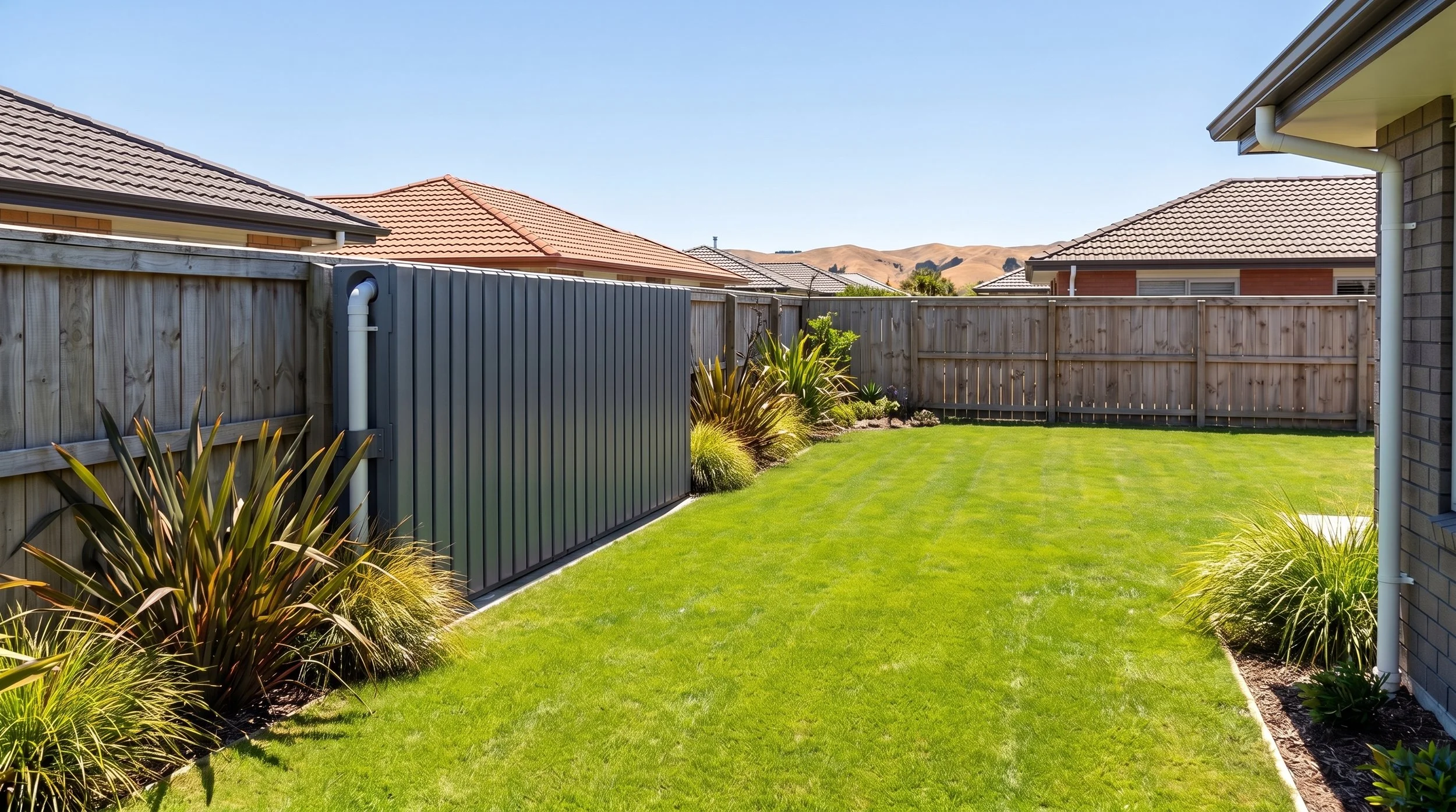
New Zealand is heading into a strong El Niño season. NIWA declared the event in 2026 and expects it to peak over the 2026–27 summer, with a chance of ranking among the strongest on record. For the north and east of the country that means less rain through the months when gardens, tanks and town supply are already under the most pressure.
A rainwater tank answers this by holding water from the wet months and releasing it through the dry ones. The obstacle on most urban sections is not the idea, it is space. A conventional round tank needs a footprint many properties simply do not have. Slimline tanks were designed for exactly that constraint: FenceTank sits around 410mm deep and mounts to fence posts without a concrete base, and SlimCity holds 2,000 or 3,000 litres in an ultra-compact form built for space-limited urban sites.
What is a rainwater tank?
A rainwater tank collects and stores water from a roof, usually via the downpipes, for later use around a property. Stored water can supply garden irrigation, outdoor taps and, when it is plumbed in, indoor uses such as toilets and laundry.
That water arrives free of charge and independently of the mains, which is what makes it useful in a dry season.
Why does El Niño matter for water storage in New Zealand?
El Niño does not simply make the country drier. It shifts where the rain falls. NIWA's outlook shows a westerly flow anomaly developing, which pushes more rain onto the west and leaves the north and east with below-normal rainfall.
If a property sits in Hawke's Bay, Gisborne, Canterbury, Marlborough or much of the upper North Island, the coming months are the ones to prepare for. Two things tend to happen together in those regions during a dry summer. Council restrictions limit outdoor water use, and properties on tank or bore supply watch their reserves fall with no rain to replace them.
Stored water changes the position on both counts. Water captured in spring is water available in February, and it does not count against a restriction on mains use.
How much water can a small section actually store?
More than most people expect, because slimline tanks use space that is otherwise wasted.
A boundary fence line is the clearest example. FenceTank links in series along a fence, so storage scales with the length of boundary available rather than being capped by how much lawn can be given up. A property with a long side fence can build meaningful volume without losing usable ground.
Where a fence line is not available, SlimCity puts 2,000 or 3,000 litres against a wall in a narrow footprint. For smaller needs, Silo holds 800 litres per tank and stacks, so storage can start small and grow.
To put those numbers in context, a typical garden sprinkler can move well over a thousand litres in an hour. Storage is not about replacing the mains on a small section. It is about covering the outdoor demand that restrictions target first.
Which tank suits which site?
The right answer depends on the site rather than the product.
- A tight urban section with a long boundary. FenceTank along the fence, since it needs no concrete base and no separate footprint.
- A courtyard or small section with wall space. SlimCity, for 2,000 or 3,000 litres in a narrow profile.
- A modest, staged start. Silo, at 800 litres per tank, stackable as needs grow.
- A development where even a wall-mounted tank is tight. StormPANEL is an ultra-slim above-ground tank holding 1,000 litres, made for space-limited developments.
Most properties end up with a combination. The point is to match the storage to the space that is genuinely available.
What makes stored water usable?
A tank on its own is a reservoir. Two things turn it into supply.
The first is pressure. A RainSaver pump delivers stored water to garden taps, toilets and laundry at proper mains-like pressure, and switches to mains automatically when the tank runs low. Without it, stored water only serves whatever a gravity feed can reach.
The second is water quality going in. A Leaf Diverter fits an 80mm downpipe and separates leaves and debris before they reach the tank. Cleaner water in means less sediment, less maintenance and better water coming back out.
When should a tank be installed?
Before the dry period, not during it. A tank fills from rain, so it needs wet months to build a reserve. Installing in spring means the tank is full going into summer. Installing in February means owning an empty tank through the season it was bought for.
With El Niño expected to peak over the coming summer, spring is the window.
FAQ
Do I need council consent for a rainwater tank?
It depends on the council, the tank size and whether the tank is plumbed into the house. Garden-use tanks are often straightforward, while a tank connected to indoor plumbing usually involves more. WaterSmart works through the local requirements as part of the design.
Can rainwater be used for drinking?
Not without treatment. Roof water suits garden, outdoor, toilet and laundry use as collected. Drinking-quality supply requires a treatment system suited to the site.
How much rainwater can a roof actually collect?
Roughly one litre per square metre of roof for every millimetre of rain. A 150 square metre roof therefore yields about 1,500 litres from 10mm of rain, so tanks fill faster than most people assume.
Will a tank still be useful if El Niño turns out milder than forecast?
Yes. Stored water lowers mains use in any year, which matters more as metered, usage-based water billing spreads across New Zealand. A dry summer makes the case urgent rather than creating it.
Does a slimline tank hold less than a round tank?
Per unit, usually. Slimline tanks make up the difference by linking together and by fitting where a round tank cannot go at all, which is the relevant comparison on a constrained site.
Getting started
The useful first step is working out how much water a property needs through a dry spell and how much space it genuinely has. From there the storage, the pump and the pre-tank filtration can be sized together.
WaterSmart designs and supplies rainwater storage across New Zealand, from slimline tanks on tight urban sections to in-slab systems under driveways. Talk to the team about your site before the dry months arrive.
Sources:
NIWA (Earth Sciences New Zealand), El Niño declared, expected to intensify into one of the strongest on record — https://niwa.co.nz/news/el-nino-declared-expected-intensify-one-strongest-record
NIWA, Seasonal Climate Outlook — https://niwa.co.nz/climate-and-weather/seasonal-climate-outlook