
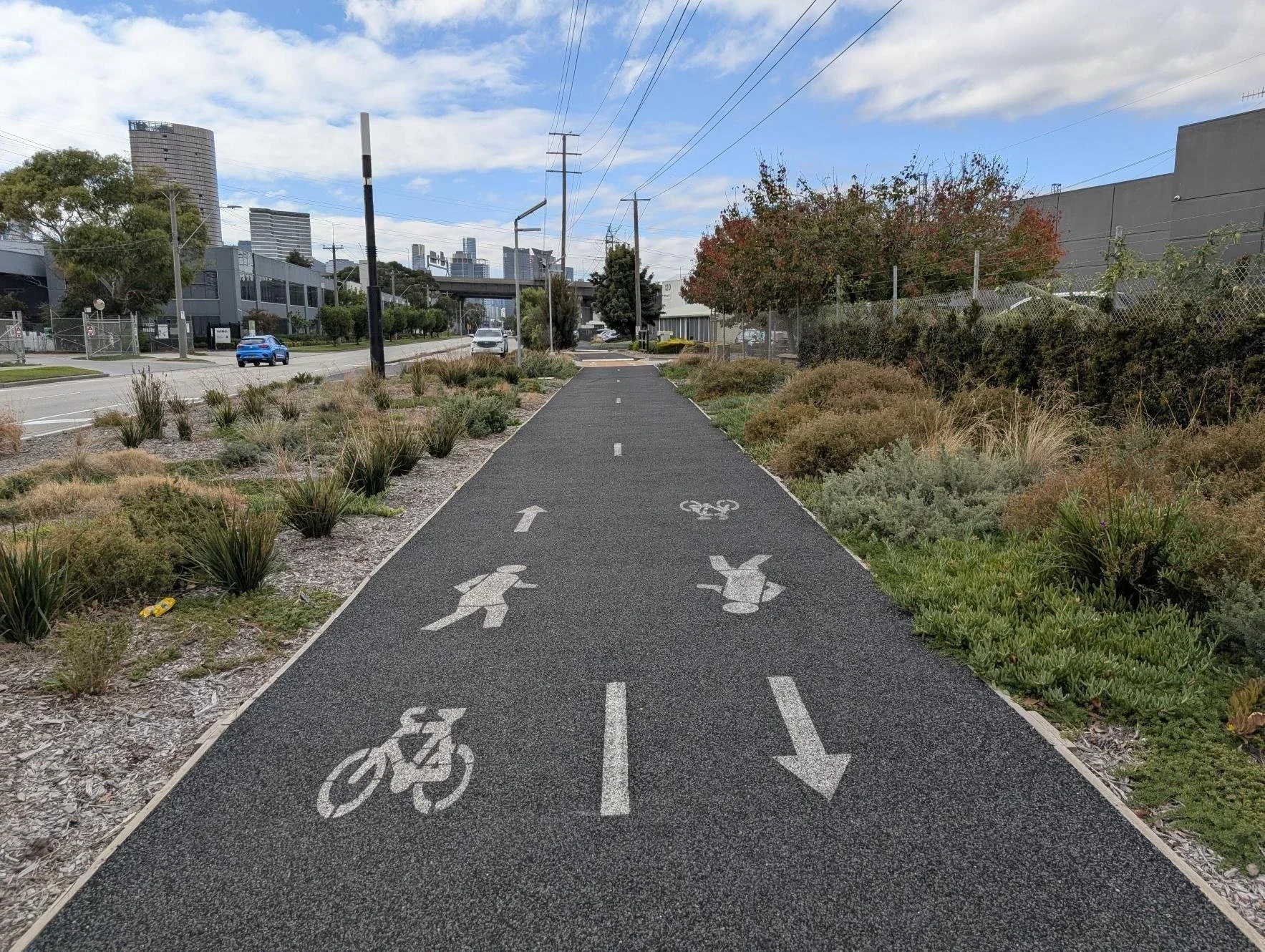
Porous Lane permeable pavement cycle and walking lane in Melbourne City.
When permeable pavements are discussed, the conversation usually centres around hydraulic performance.
How much rainfall infiltrates? How much runoff can be reduced? How much water can be stored beneath the pavement before discharging to the stormwater network?
These are important questions and have been the focus of permeable pavement research for many years. An equally interesting question is what happens to stormwater as it moves through the pavement profile.
That question has been central to ongoing research at the University of Melbourne, where Porous Lane has been developed and continuously refined through laboratory testing, field trials and long-term performance monitoring. Alongside structural performance, durability and hydraulic behaviour, researchers have increasingly turned their attention to stormwater quality.
Looking below the surface
As Stormwater moves through the pavement profile, several natural treatment processes begin to occur.
The interconnected voids within the Porous Lane surface physically filter suspended sediment from runoff. This is particularly important because many urban contaminants (including heavy metals) are particulate-bound, meaning they travel attached to sediment rather than dissolved in water.
Below the surface, the aggregate storage layer continues the process. Water slows as it moves through the pavement, allowing additional sediment to settle while increasing contact with the aggregate. This promotes adsorption of contaminants, while naturally occurring biofilms that develop over time assist in reducing nutrients such as nitrate and total nitrogen.
Collectively, these mechanisms create a treatment train within the pavement profile, allowing the pavement to contribute to improving stormwater quality as well as managing stormwater quantity.
What did the research show?
To better understand these processes under real operating conditions, University of Melbourne researchers monitored a full-scale Porous Lane installation in Adelaide over a 17-month period.
The study demonstrated reductions in a range of common urban stormwater pollutants, including:
Nitrate-nitrogen: up to 95%
Total nitrogen: up to 40%
Total suspended solids (TSS): up to 66%
Turbidity: up to 89%
Significant reductions in heavy metals including copper, chromium, cadmium, lead, nickel, iron and aluminium.
These pollutants are familiar to anyone working in stormwater management. Suspended solids transport many contaminants, nutrients contribute to degraded water quality, and heavy metals can accumulate in aquatic ecosystems over time. Improving water quality at the source has the potential to deliver benefits well beyond the development boundary.
What does this mean for New Zealand?
Traditionally, pavements and stormwater treatment have been viewed as separate parts of a development. One provides a durable surface for pedestrians and vehicles, while the other manages water quality.
Interestingly, Auckland Council's GD01 already recognises the stormwater management benefits of permeable pavements in certain applications. In some situations, where runoff is managed using permeable paving, additional water quality treatment may not be required. However, permeable pavements are not currently recognised as stormwater treatment devices in their own right, meaning their contribution to pollutant removal is not formally assessed in the same way as proprietary treatment systems.
The University of Melbourne research suggests those functions don't always have to be separate. A permeable pavement can provide a durable surface, reduce runoff, temporarily detain stormwater and contribute to improving water quality all within the same footprint.
As New Zealand's towns and cities continue to grow, infrastructure will increasingly be expected to deliver multiple outcomes. Research-led innovations such as Porous Lane demonstrate how a single asset can contribute to stormwater management, urban tree health and resilient public spaces, while making productive use of recycled materials.
At Watersmart, we're excited to work alongside researchers at the University of Melbourne, councils and industry to help bring this research into the New Zealand context. Our hope is that continued collaboration and local evidence will support future conversations around stormwater guidance, giving engineers and developers another evidence-based tool to consider when designing resilient, water-sensitive communities that uphold the principles of Te Mana o te Wai.
Want to learn more? Download the full peer reviewed research paper below.