
Fast-track Development Still Needs Infrastructure Certainty
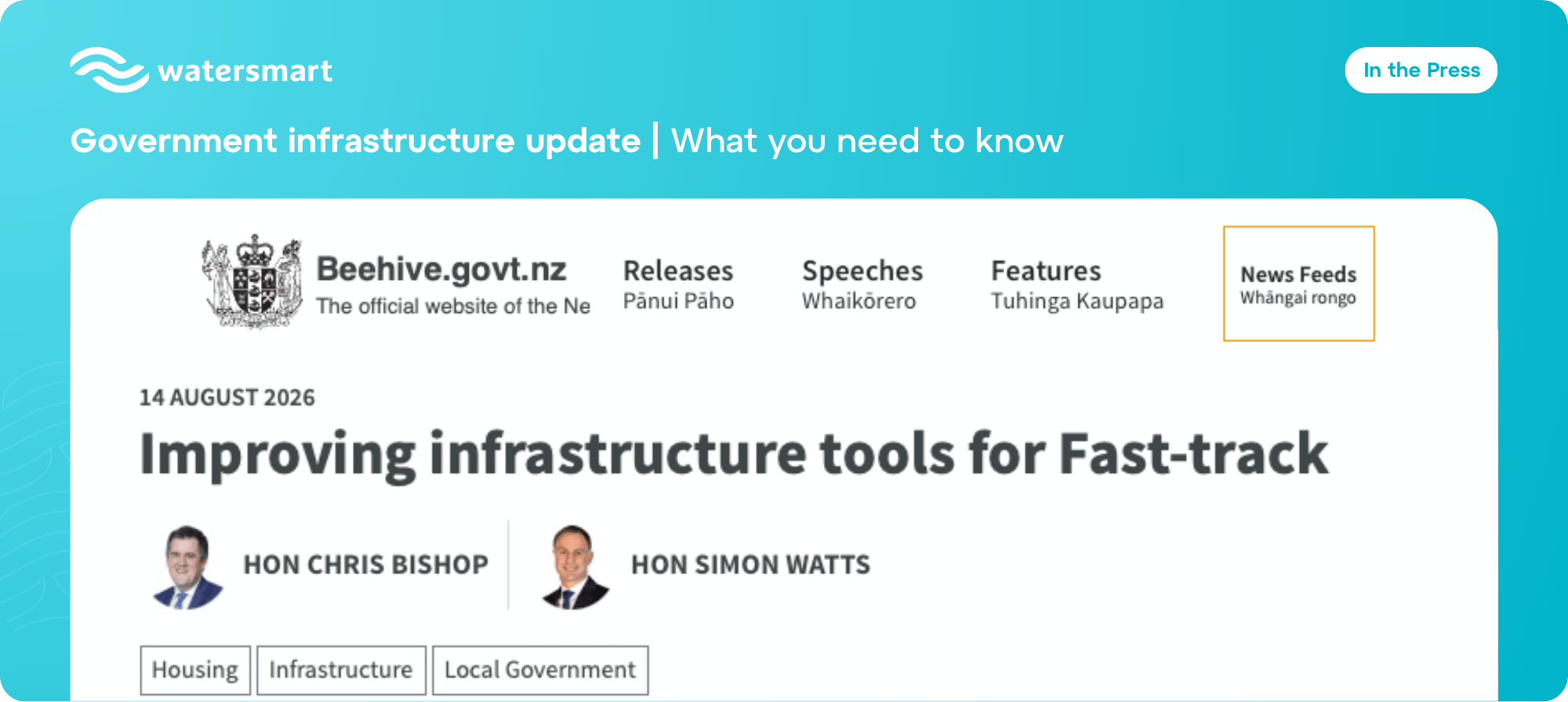
New Zealand Government announcement: Improving infrastructure tools for Fast-track
Fast-track approval can help a significant development move through the consenting system sooner. It does not, by itself, determine how the roads, water, wastewater and stormwater infrastructure needed to service that development will be funded or delivered.
That distinction sits behind the Government’s recently announced changes to infrastructure funding settings for future Fast-track developments.
What has been announced?
Under the current development contributions system, the contribution applying to a project is generally set when its resource consent application is lodged.
The Government plans to give councils more flexibility to update their development contribution policies after an eligible Fast-track application has been made. The proposed changes are intended to address situations where a development:
Proceeds ahead of planned council infrastructure investment
Uses network capacity intended for already-zoned areas
Creates infrastructure impacts across council boundaries
Generates growth-related costs that are not adequately covered by an existing policy
Where the changes apply, councils would have six months following Fast-track approval to adopt the necessary policy changes.
They would not apply to Fast-track projects that have already been approved or have lodged a substantive application by the time the amendment takes effect.
The Government describes this as an interim measure ahead of the proposed development levies system, which is expected to replace development contributions from 2029.
Why does this matter?
Project approval and infrastructure readiness are distinct.
A project may be suitable for Fast-track approval while further work is still required to establish how it will connect to existing infrastructure, whether upgrades are needed and who will fund and deliver them.
This is particularly relevant for developments that sit outside the sequence of planned council investment. If infrastructure has not already been planned or funded for that location, the cost and timing of servicing the development may be less certain.
The proposed changes are intended to give councils another way to recover costs reasonably attributed to the growth created by an eligible Fast-track development. For project teams, this reinforces the importance of investigating infrastructure requirements before key design and commercial decisions are fixed.
What should project teams establish early?
Every development will have different requirements, but several questions are worth addressing from the outset:
What capacity is currently available across water, wastewater, stormwater and transport networks?
Is that capacity already allocated or intended to support planned growth elsewhere?
What new or upgraded infrastructure will the development require?
Will any of that infrastructure sit outside the development boundary?
Are neighbouring councils or other infrastructure providers affected?
Who will design, fund, deliver, own and maintain each asset?
Could the timing of infrastructure delivery affect when the development can proceed?
Would a development agreement provide greater certainty?
The Government has encouraged councils and developers to consider development agreements. These can help clarify how infrastructure will be provided, how costs will be allocated and what each party is responsible for delivering.
The right arrangement will depend on the project. The benefit is that assumptions, costs and responsibilities can be discussed before they become more difficult to resolve.
Where can onsite water management fit?
Simply having a new connection point does not show the effect a development may have on water infrastructure. Project teams also need to understand the demand behind it, including expected potable water use, wastewater discharge, and stormwater runoff.
Once that demand is understood, engineers and authorities can better assess what the existing network can accommodate and what additional infrastructure may be required.
Some developments may also have opportunities to manage part of their water demand or stormwater response onsite. This could include water reuse, rainwater detention, retention, infiltration or monitoring.
These measures do not automatically replace public infrastructure and reduce development contributions. Any effect on infrastructure requirements would need to be supported by project-specific modelling and agreement with the relevant authority. However, they can provide additional options when considered early enough.
Certainty before delivery
Fast-track approval can shorten part of the development process, but it does not remove the need to establish how a project will be serviced.
Understanding demand, available capacity, infrastructure costs and delivery responsibilities early gives councils and development teams a stronger basis for making decisions. As development accelerates, that certainty will become increasingly important.
Watersmart works with developers, architects, engineers and councils to assess water demand and explore practical water, wastewater and stormwater options during the early stages of development. To discuss the infrastructure requirements of an upcoming project, get in touch with our team.