
Sponge Cities: Building Urban Resilience Without Slowing Growth
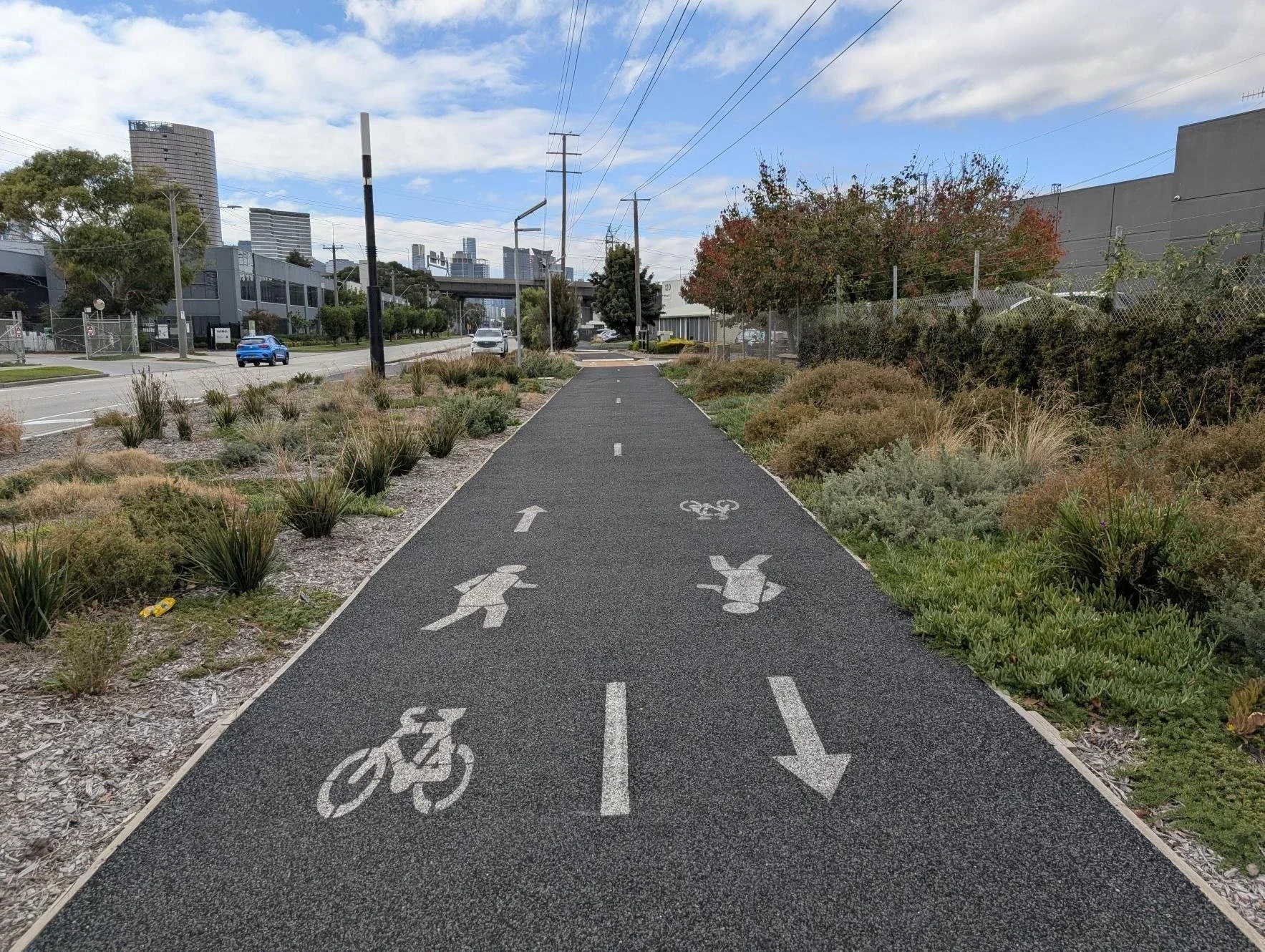
Pictured: Porous Lane bike path and walkway in Melbourne, Australia
Across Aotearoa and the wider Oceania region, cities are facing a defining infrastructure challenge. Rainfall events are becoming more intense. Urban areas are densifying. Existing stormwater networks which were largely designed for historical climate patterns, are being pushed beyond capacity.
The response cannot simply be “bigger pipes.”
Around the world, leading cities are adopting a more integrated approach: designing urban environments to behave like sponges — absorbing, storing, filtering and gradually releasing rainwater rather than immediately channelling it away.
This is the foundation of the sponge city movement and it offers New Zealand a significant opportunity.
WHAT IS A SPONGE CITY?
The sponge city concept reimagines urban areas as living systems that work with natural water cycles rather than against them. Instead of treating rainfall as waste to remove, sponge cities combine:
Parks and wetlands that temporarily store floodwater
Rain gardens and bio-retention systems
Green roofs
Permeable pavements
Vegetated corridors
Underground storage tanks and controlled discharge systems
The key is integration. Surface infrastructure works in tandem with engineered subterranean systems. Water is absorbed, stored and released in a controlled manner, protecting assets and communities.
WHY THIS MATTERS IN NEW ZEALAND
Cities like Auckland are already, in many ways, naturally viewed as sponge cities. Extensive green space, volcanic landscapes and coastal environments have historically supported drainage and infiltration.
However, rapid densification and intensifying rainfall are reducing that natural buffer. Impermeable surfaces are increasing while climate volatility is rising.
Relying solely on inherited green space is no longer sufficient. The shift required now is intentional design. We want to enhance natural systems while embedding high-performance infrastructure that actively manages water at source.
PERMEABLE PAVEMENTS: TURNING SURFACES INTO STORMWATER ASSETS
Among sponge city tools, permeable pavements are one of the most scalable and immediately deployable solutions.
Unlike conventional asphalt or concrete, permeable pavement materials are designed with large pores and open gradation. This allows rainwater to infiltrate directly through the surface into an underlying aggregate layer.
During heavy rainfall:
Water infiltrates rapidly
Peak flows are reduced
Downstream pipe pressure is relieved
Flood risk is lowered
During lighter rainfall:
Retained water can evaporate
Surface cooling occurs
Urban heat island effects are mitigated
Permeable pavements also provide built-in water treatment. As stormwater infiltrates, it undergoes:
Mechanical retention of sediments
Physical adsorption of pollutants
Chemical reactions within the aggregate matrix
Biodegradation by microorganisms in the sub-base
This layered filtration improves water quality before it reaches groundwater or waterways.
TANKS AND CONTROLLED STORAGE: MANAGING WHAT CANNOT INFILTRATE
Not all rainfall can infiltrate. In high-density areas or constrained sites, engineered storage becomes essential.
Stormwater tanks:
Capture excess rainfall during peak events
Temporarily store stormwater onsite
Release water slowly at controlled discharge rates
Reduce downstream flooding risk
Protect ageing infrastructure networks
When integrated with permeable pavements and green infrastructure, tanks provide system resilience and create a robust hybrid network capable of adapting to climate uncertainty.
THE ECONOMIC AND COMMUNITY BENEFITS
Investing in flood resilience delivers long-term savings. Evidence shows that every $1 invested in resilience can save $4 in recovery costs.
Beyond financial returns, sponge cities:
Enhance biodiversity
Improve air quality
Reduce urban heat
Strengthen public health outcomes
Increase property value and investor confidence
GROWTH AND RESILIENCE CAN ADVANCE TOGETHER
Urban intensification is essential but growth should not require compromising resilience.
By embedding permeable pavements, distributed storage tanks, green infrastructure and intelligent discharge systems into development frameworks, we can densify responsibly while protecting community wellbeing.
New Zealand has the expertise — from skilled landscape architects to forward-thinking engineers — to become a global case study in sponge city implementation.
The future of urban infrastructure will not be defined by how quickly we move water away but by how well we manage it where it falls.