
Stormwater Management in NZ: What Developers Need to Know (and Get Right)
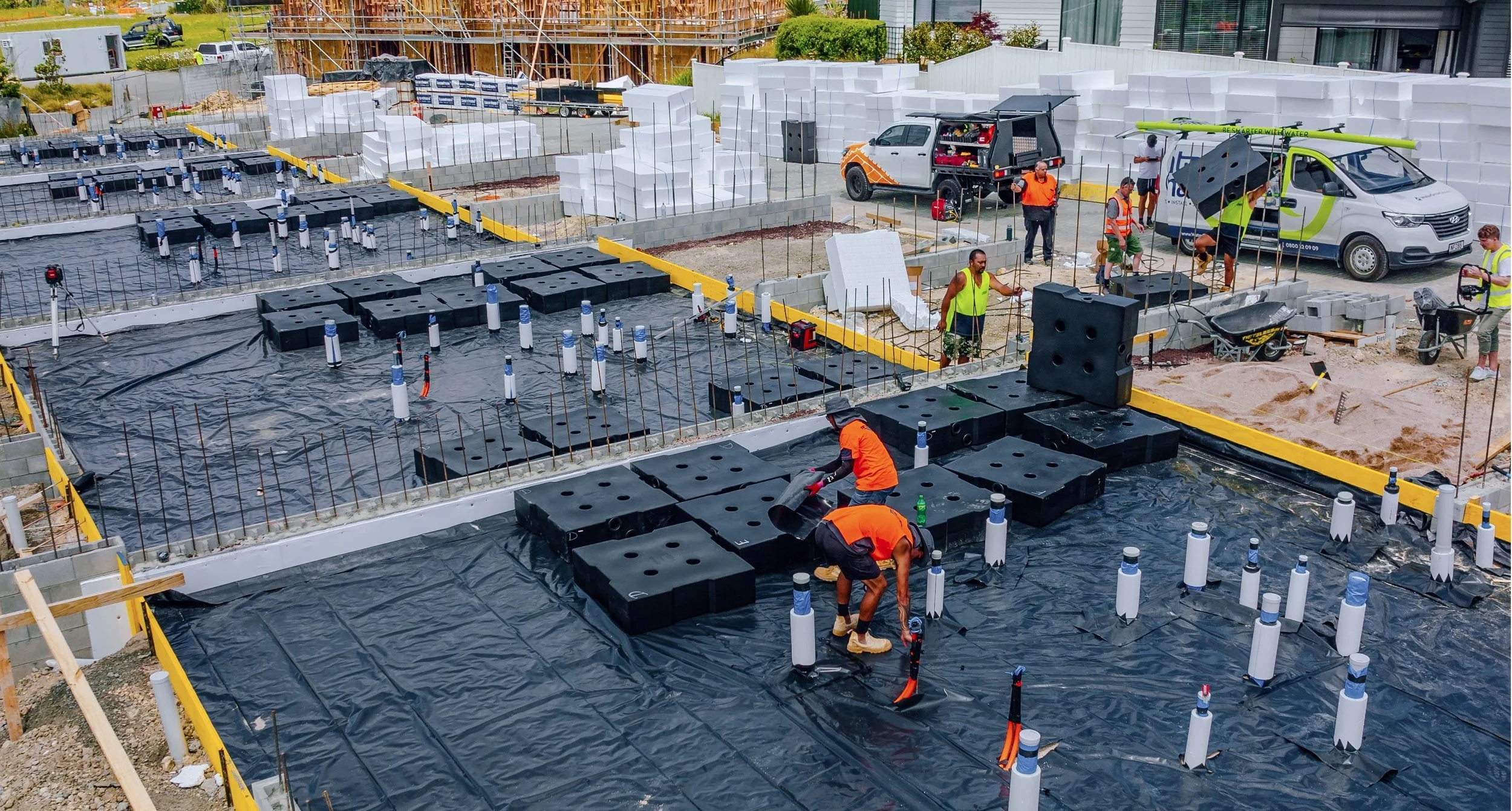
New Zealand's councils are getting serious about stormwater. As urban density increases and extreme weather events become more frequent, the rules around on-site detention and stormwater attenuation have tightened significantly — and the consequences of getting it wrong are showing up on job sites across Auckland and beyond.
If you're developing, building, or specifying for a project in NZ right now, here's what you need to understand.
Why Stormwater Management Has Become a Bigger Deal
Traditional stormwater infrastructure was designed for a different era — lower density, less impervious surface, and weather patterns that were, frankly, more predictable.
That's changed. As cities have grown and climate pressures have mounted, councils have had to respond. Auckland Council's Stormwater Management Area Flow (SMAF) controls now require many new developments to manage runoff on-site rather than discharging straight to the council network. Other councils across NZ have adopted similar frameworks.
The result: on-site detention (OSD) is no longer optional on most new builds. It's a consent condition.
What On-Site Detention Actually Means
OSD systems slow down the rate at which stormwater leaves a site. The goal isn't necessarily to store water permanently — it's to attenuate the peak flow so the downstream network isn't overwhelmed.
In practice, this means capturing rainwater in a storage system and releasing it through a controlled orifice at a restricted rate. Engineers calculate the required volume based on site area, pre vs post development site coverage and the local council's flow rate targets.
The system has to:
Hold enough volume to manage the design storm event
Restrict outflow to the council's specified rate
Be accessible for maintenance
Not create structural, flooding, or building consent issues
That last point is where most projects run into trouble.
The Problem with Traditional Detention Solutions
Large underground tanks have been the go-to for decades. They work — but they come with serious limitations on modern NZ development sites:
Space requirements: Large tanks need significant footprint and depth, which is a problem on the tight, high-density sections that dominate Auckland development today
High invert levels: Many sites can't use buried tanks because the council stormwater connection is higher than the underground tanks allow
Cost and construction complexity: Excavation, piling, waterproofing, and backfilling add time and money before you've even poured a slab
Rocky or sloping ground: Common across many NZ sites, particularly in Auckland's volcanic terrain
These constraints push engineers and developers toward systems that can work within the site's actual conditions — not the ideal site conditions that older systems were designed for.
Systems Built for NZ's Real Conditions
Aquacomb was designed specifically to address the constraints that traditional tanks can't handle. As NZ's first in-slab stormwater system in pre-packaged kit form, it installs under driveways, in concrete slabs, under decks, patios and lawns — using space that would otherwise be wasted.
Key advantages for stormwater detention:
Works on sloping sites and sites with high invert levels
No excavation or additional land required — the system lives within the proposed slab or structure
Modular design: scale from 250L to 30,000L+ depending on the detention requirement
Up to 38% cheaper installed in-slab than traditional underground tanks
15,000+ installs across Australia and NZ with zero recorded leaks
For projects where space is the constraint — small urban lots, infill development, multi-unit builds — Aquacomb solves a problem that used to require expensive engineering workarounds.
FenceTank takes a different approach for sites where above-ground storage is viable. At just 410mm deep, it's one of the narrowest above-ground tanks available in NZ. It mounts to fence posts, holds 1,000L per unit, and can be linked in series to scale storage capacity to project requirements.
For developments where the detention volume is modest and above-ground installation is practical, FenceTank delivers fast, cost-effective compliance.For sites with larger underground storage needs, StormVAULT is built for most NZ soil types and water table conditions — including beachfront and hillside sites where other systems struggle.
Each solution addresses different site conditions. The right choice depends on the specific constraints of the project.
What Engineers and Developers Should Be Doing Now
If stormwater detention isn't on your checklist early in the design phase, it usually becomes an expensive problem later. A few things to address upfront:
Check your council's SMAF or flow rate requirements early
Every council has different thresholds. Some require OSD on any impervious surface above a certain area. Others have zone-specific rules. Getting this confirmed before design is locked in saves significant rework.
Assess your site constraints honestly
High invert levels, rocky ground, tight sections, and sloping sites all affect which detention system is viable. Don't design for an idealised site.
Factor in the AquaPit or equivalent access point
Any detention system needs a point of entry and exit for water — and maintenance access. The Aquacomb AquaPit is designed to handle this in a compact, cleanable format. Annual maintenance is simple: a wet-vac to clear sediment.
Consider combining detention and reuse
Many projects now combine OSD requirements with rainwater reuse for toilet flushing and laundry. Aquacomb supports both in a single system — reducing the total install footprint while ticking two compliance boxes at once.
Getting It Right the First Time
Stormwater management in NZ is only going to get more regulated, not less. Councils are under pressure from both central government and communities to prevent downstream flooding, protect waterways, and future-proof infrastructure as density increases.
The projects that handle it well are the ones that treat stormwater as a design consideration from day one — not a compliance afterthought that gets resolved at the last minute with an expensive retrofit.
Watersmart's team works alongside engineers, architects, and developers to design stormwater systems that work within the real constraints of NZ projects. Get in touch to talk through your site's requirements.