
Summer Water Resilience: Smart Detention & Reuse in NZ
New Zealand Summers bring longer dry spells, sudden downpours, and tighter water restrictions. If you are a homeowner, builder, or developer, now is the time to set up smart detention and reuse systems that keep projects compliant and households resilient through summer.
In this guide, you will see how detention differs from reuse, which systems fit tight urban sites with high invert levels, what capacities are typical, and how fast you can plan and install before the dry season hits. You will also find clear pointers on council compliance and realistic lead times.
Detention vs reuse, what actually changes on site
Stormwater detention slows the release of roof and hard-surface runoff to the council network to reduce flooding risk. You size a detention volume, store water temporarily, then release it through a controlled outlet.
Rainwater reuse stores water for on-site use such as toilets, washing machines, and irrigation. You keep the water and draw it down with a pump rather than throttling it to the street.
Most councils will specify a detention volume to manage peak flow. Many also encourage, or require, a separate reuse allocation to reduce demand on potable supplies. You can combine both functions in one integrated system with a dedicated detention compartment and a reuse compartment that feeds non-potable uses.
Your consent documents will typically call for a design report, hydraulic calcs, and system schematics that show volumes, outlet controls, and cross connections.
Above-ground slimline options for fast wins
For rapid deployment on homes and small lots, slimline above-ground systems are the quickest path to summer readiness.
FenceTank: Sits neatly along fence lines, typically 1,000 L per unit with about 408–410 mm depth. You can daisy-chain units to scale storage without eating valuable yard space. Installation is straightforward with coach screws to posts, and there is no concrete base required in many cases.
Slim City Tank: With options available in both 2000L and 3000L, Slim City is most ideal for developments that require slightly larger capacity. With its sleek slimline design your project can enjoy added capacity without taking up much space.
stormPANEL: Ultra-slim profile, 1,000 L per unit, ideal where you have narrow side yards and need a tidy, modular look. Units connect easily to downpipes and to each other.
Silo: A tall, compact cylinder at 800 L per unit. The vertical footprint suits tight courtyards and small urban sections.
These systems shine where excavation is impractical or where consent timeframes are tight. For reuse, pair any of the above with a suitable pump and simple plumbing to toilets, laundry cold supply, and external taps.
For detention, you can integrate a throttled overflow to meet council peak flow limits while preserving a reuse compartment for daily demand.
If you are comparing storage options or planning to harvest from larger roof areas, it can help to review the broader range of rainwater tanks and related options using anchors like rainwater harvesting and water tanks that match your site plan.
Hidden and underground systems for high invert levels and tight sites
When the connection point to the street is high or shallow, or when space is at a premium, hidden and underground systems come into their own.
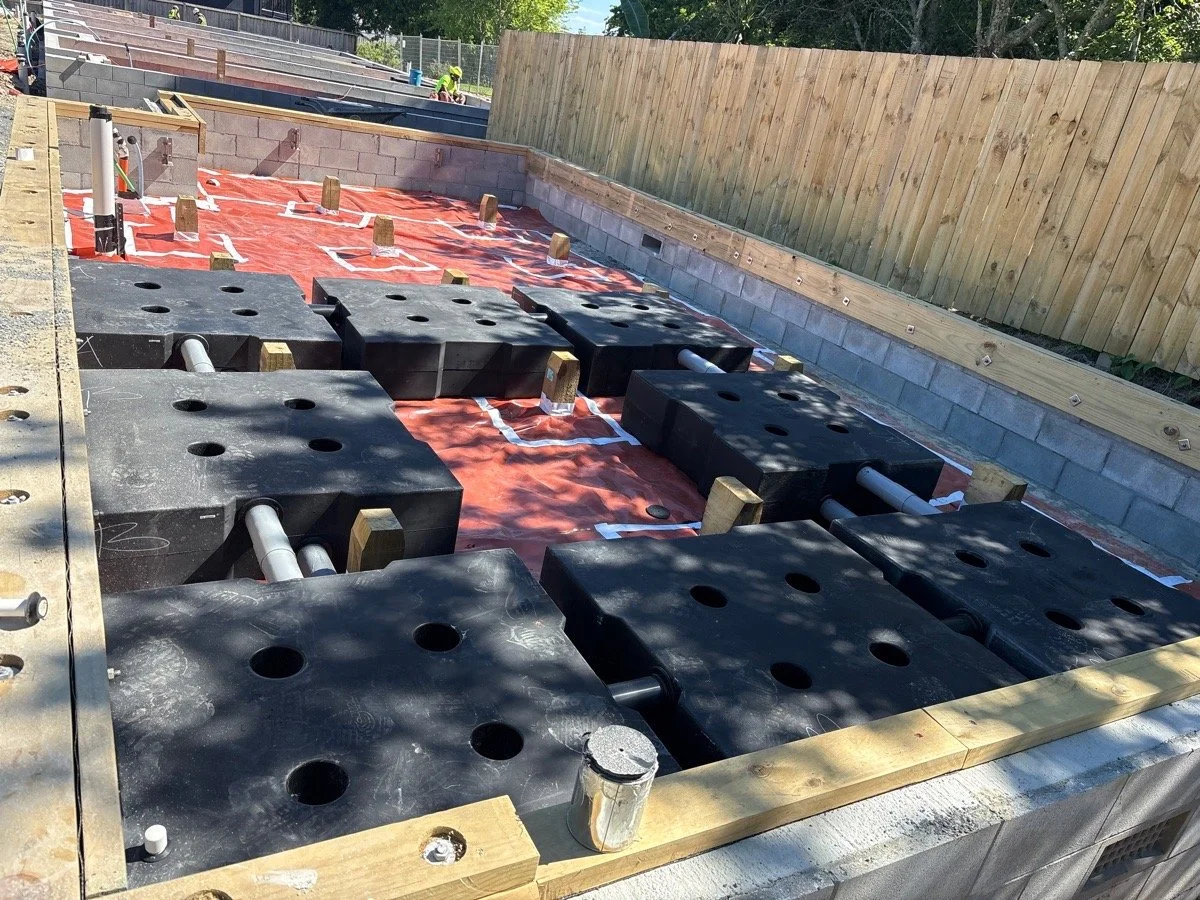
Aquacomb: Modular pods that fit under slabs, driveways, or decks. Ideal for high invert sites because you can install at finished floor level or at-grade, avoiding deep excavation. Systems commonly range from around 3,000L to 30,000L by combining pods. Aquacomb can be configured for detention, reuse, or both, and it is known for quick installation, often in hours, with BRANZ third-party QA noted for in-slab use.
stormVAULT: A heavy-duty underground detention tank designed to handle varied soil and groundwater conditions across New Zealand. If your council requires a robust buried detention asset for compliance, stormVAULT provides a durable, code-aligned backbone with a 15-year warranty. Which is best for high inverts and tight urban sites? If you want to preserve outdoor space and avoid cranage or deep trenching, Aquacomb under-slab or under hardscape is usually the most flexible choice.
If you need a conventional buried detention unit with strong structural performance and council familiarity, stormVAULT is a safe, compliant option.
Typical capacities and how to size for summer
Small homes wanting basic reuse for toilets, laundry, and garden: 2,000 to 5,000 L across two to five slimline units or a modest pod arrangement.
Family homes with garden irrigation and higher reuse demand: 5,000 to 10,000 L.
Multi-dwelling, terraced, or infill developments: 10,000 to 30,000 L total across shared or staged systems, with detention and reuse volumes clearly separated in design drawings.
Your actual volume will be driven by council detention requirements, roof area, local rainfall patterns, peak flow limits, and how much of your non-potable demand you want to offset. As a rule of thumb, do not let detention consume your reuse buffer. Specify a controlled outlet for the detention compartment so your reuse water remains available through dry spells.
Installation timeframes you can hit before summer
Speed matters in the lead up to restrictions. Here is what you can plan for in typical conditions.
Above-ground slimline tanks: Often installed in a day once the base or fixings are ready. Plumbing integration for reuse can usually be completed within one to two days depending on complexity and pump commissioning. avoid piling or cranage.
Aquacomb: Rapid installation, frequently in hours for underslab or under-drive configurations, provided base prep and coordination with the builder are set. This approach can keep builds on programme and
stormVAULT: Timeframes vary by excavation, ballast, backfill, and inspection requirements. Many installs complete within a few days once the hole is prepared and inspections are booked.
If you are integrating pumps, backflow, first-flush and filtration, allow an extra day for fit-off and testing.
For multi-lot projects, staged delivery can keep progress steady while you pour slabs and progress services.
Lead times to expect from order to install
Lead times move with seasonal demand. As a planning guide for Summer:
Standard slimline tanks and fittings: 2 to 4 weeks from order to site delivery is common in spring, with installation scheduled shortly after.
Aquacomb pods: Often available on short lead times, with configuration and layout confirmed during design. Allow 2 to 4 weeks to be safe in peak season.
stormVAULT and associated civil works: 3 to 6 weeks including approvals, excavation scheduling, and inspections.
If you need a pump set matched to your reuse flow rates and pressure, allow a little buffer so commissioning aligns with your plumber’s programme.
Council compliance and navigating restrictions
Detention is about peak flow control. Reuse is about reducing potable demand and building resilience. A compliant design will:
Document detention volume, outlet size, and emergency overflow path.
Separate reuse and detention compartments where required, and prevent cross contamination with appropriate backflow devices.
Provide maintenance access, screened inlets, and clear O&M guidance.
Reference relevant standards and, where applicable, third-party QA such as BRANZ for in-slab systems.
For water restrictions, reuse systems help you keep gardens green and toilets flushing without relying fully on mains. Pairing roof collection with a smart pump and basic filtration keeps day-to-day use going even when hose bans arrive.
If you want deeper savings inside the home, a greywater recycling system can reduce mains use further by treating shower and laundry water for reuse in toilets, gardens, and more.
Your next steps, tailored to site constraints
Tight urban site with a high invert connection: Choose Aquacomb under slab or under hard surfaces for a compact, compliant detention plus reuse layout that installs quickly and preserves usable space.
Straightforward retrofit for a home: Go with slimline FenceTank, stormPANEL, or Silo, then add a right-sized pump and simple plumbing to toilets, laundry, and garden taps.
Buried detention requirement with a durability focus: stormVAULT offers a robust, council-aligned detention backbone.
From planning and design to supply, install, and service, we act as your end-to-end partner.
We will size the detention and reuse volumes, coordinate with your builder and plumber, and deliver a rapid, compliant setup that saves time, money, and space.
Summary
Summer resilience starts now. Detention protects the network by throttling peak flows, while reuse keeps water available for daily needs when restrictions bite. For fast installs and tidy aesthetics, slimline above-ground units are hard to beat.
For high invert levels and tight sites, Aquacomb hides storage where you have space to build, and stormVAULT provides heavy-duty underground detention when you need a conventional buried unit. Plan for lead times of roughly 2 to 6 weeks depending on the system, and aim to install before the heat arrives.
If you want a single team to handle design, supply, installation, and servicing, we are ready to help you build a smarter, more resilient water system for your home or development.