
In June 2026, New Zealand passed a law that lets licensed plumbers and drainlayers certify their own work instead of waiting for a council inspection. Endorsement opens through the Plumbers, Gasfitters and Drainlayers Board by the end of 2026. The scope the Government announced covers most residential plumbing and drainage, some commercial work, and septic and stormwater retention tanks, on buildings up to three storeys.
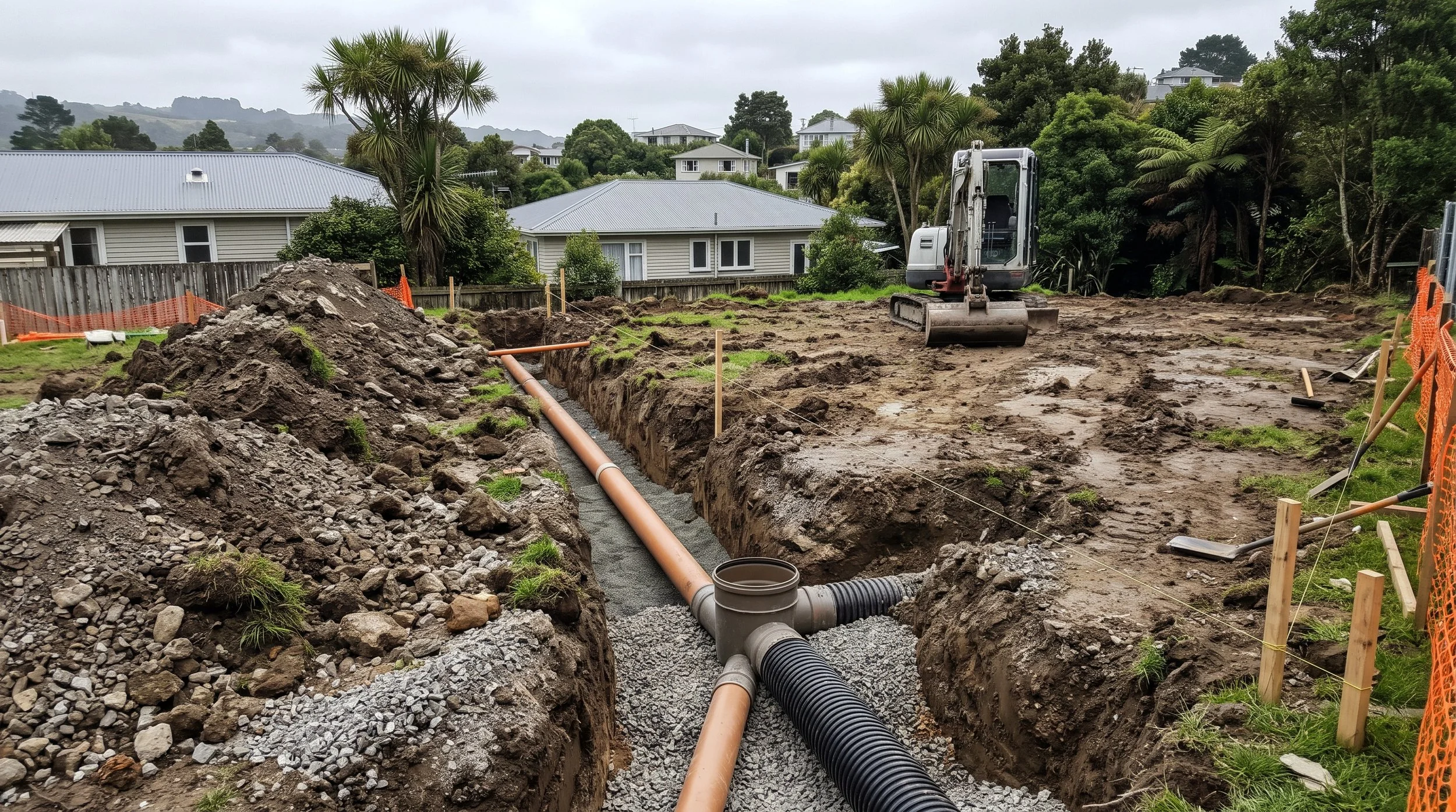
For most trades the change means fewer delays. For stormwater work it also moves the burden of proof. An inspector's visit used to confirm that work was done correctly. Under self-certification, the installer's own records do that job, and stormwater systems are mostly buried, concealed or built over within days of going in.
What is plumber and drainlayer self-certification?
Self-certification is an opt-in scheme in which a licensed plumber or drainlayer, endorsed by the Plumbers, Gasfitters and Drainlayers Board, certifies that their own work complies with the building consent. The building consent authority accepts that certificate in place of an inspection.
It sits alongside the existing system rather than replacing it. Work done by a practitioner who has not been endorsed, or work outside the scheme's scope, still goes through the usual inspections.
What changed in 2026?
Three things, in quick succession.
The scope widened. In April 2026, Building and Construction Minister Chris Penk announced that the scheme would cover the majority of residential plumbing and drainage work rather than basic bathroom installations alone. The expanded scope includes some commercial work, septic tanks, and stormwater retention tanks in rural and urban areas. It applies to buildings up to three storeys, excluding apartments, that use standard designs and do not affect fire-rated or shared walls. The detailed scope is being set through regulations.
The law passed. The Building and Construction Sector (Self-certification by Plumbers and Drainlayers) Amendment Act 2026 received royal assent on 2 June 2026. It amends the Building Act 2004 and the Plumbers, Gasfitters, and Drainlayers Act 2006.
Endorsement is about to open. Practitioners will be able to apply to the Board for endorsement by the end of 2026. Until they are endorsed, nothing changes on site.
A separate scheme for residential builders is still being finalised, and the Government has agreed to move the sector from joint and several liability to proportionate liability. Both are on their way, but this article covers the plumbing and drainlaying scheme, which is the one already in law.
Who will be able to self-certify?
Plumbers and drainlayers who are licensed and in good standing with the Board, and who apply for and receive endorsement. They also need adequate means to meet any civil liability. MBIE has indicated that this assessment can rely on an employer's insurance.
The scheme is voluntary. A practitioner can keep working through council inspections if they prefer.
Where does responsibility sit now?
With the person who signs. A consent authority must accept a self-certification certificate when the documentation is complete. It checks completeness, has no discretion to refuse a complete certificate, and is not liable for defects in self-certified work.
MBIE has also said that an endorsed practitioner could be held individually liable for defects after a code compliance certificate is issued, including where the company they worked for has ceased trading. That is a real shift for individual tradespeople, and it is the strongest reason to keep a thorough record of every job.
Why is stormwater work different?
Because almost none of it stays visible. Detention tanks sit under slabs and driveways. Drainage runs are backfilled. Retention tanks are connected and closed off. Once a site moves on, the opportunity to see how the work was done has gone.
Durability raises the stakes. Under Building Code clause B2, systems installed within a building structure, such as in-slab stormwater detention, need a 50-year service life, and systems beneath driveways, paths or decks are generally expected to meet 15 years. A fault in that kind of system usually surfaces years later, when the only way to understand what happened is the record made at installation.
That is why we set out in June that the future of compliance is evidence, not inspection. The law has since confirmed it. For stormwater, the evidence pack is the inspection.
What should drainlayers and developers do now?
Drainlayers have until endorsement opens to build the habits the scheme assumes:
Photograph every stage before it is covered, from consistent reference points, so the set reads as a sequence.
Record every test with its date, method, result and the name of the person who ran it.
Produce an as-built record for each system, showing where it actually sits and how it connects.
Check with your employer how adequate means will be assessed and what your insurance covers.
Get product-specific training from suppliers for the systems you install, so you are certifying work you have been shown how to do.
Developers and specifiers carry less of the new liability, but they still want confidence in work they will never see again:
Specify products with independent appraisal and supplier installer training behind them.
Ask for the evidence pack at handover: photos, test records and as-builts.
Keep that pack with the property records, because the next owner will need it too.
For a worked example of what that record looks like for one system, see Self-Certifying an Aquacomb Install: The Evidence to Capture at Each Stage.
FAQ
When does plumber and drainlayer self-certification start?
The law passed in June 2026. Practitioners can apply to the Plumbers, Gasfitters and Drainlayers Board for endorsement by the end of 2026, and can self-certify eligible work once endorsed.
Is self-certification compulsory?
No. It is an opt-in scheme. Work by practitioners who are not endorsed, or work outside the scheme's scope, still goes through council inspection.
Are stormwater tanks covered?
The scope the Government announced includes stormwater retention tanks in both rural and urban areas, along with septic tanks, for eligible buildings.
Does it apply to apartments?
No. The expanded scope covers buildings up to three storeys and excludes apartments, along with work affecting fire-rated or shared walls.
Is the council liable if self-certified work fails?
No. The consent authority is not liable for defects in self-certified work. Responsibility sits with the certifying practitioner.
Where to start
Self-certification rewards the installers who already work carefully, and gives them a way to prove it. For stormwater, where the work disappears within days, that proof has to be built at the time or not at all.
WaterSmart has only ever used trained and certified installers, and supports them with the documentation self-certification now asks for. Read more in Training that supports self-certification, or talk to the team about training for your crew.
Sources
Hon Chris Penk, Skilled plumbers and drainlayers scheme expands, 23 April 2026
Building and Construction Sector (Self-certification by Plumbers and Drainlayers) Amendment Bill
MBIE, Bills on self-certification and stronger licensing pass first readings
MBIE, as reported by PlaceMakers, Plumbers and drainlayers will carry individual liability
Building Performance, How self-certification for plumbing and drainlaying works