
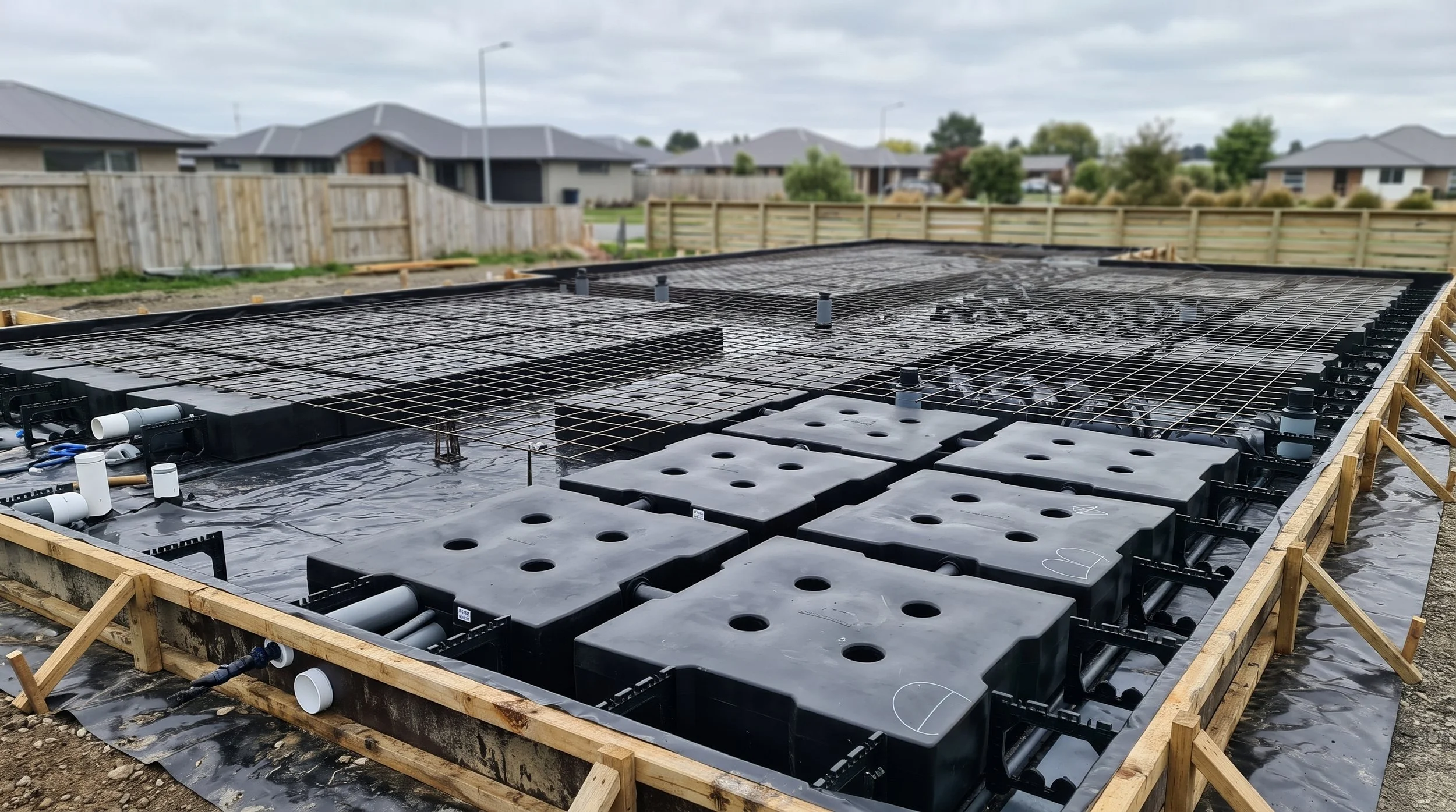
New Zealand's self-certification scheme lets endorsed plumbers and drainlayers sign off their own work, and the Government has confirmed that stormwater retention tanks sit within its scope. For an in-slab system like Aquacomb, this means the council will not come out to inspect the tank before it is covered. The building consent authority will only check that the paperwork is complete, so the installer's own records are the proof that the work complies.
So the record of how the system was placed, tested and covered becomes the evidence that it complies. The practical answer is to capture that evidence at every stage that is about to be hidden: the prepared base, the placed modules, the pressure test, and the finished system just before the slab or driveway goes over it. Each of those stages can only be photographed once.
What is self-certification?
Self-certification is an opt-in scheme in which a licensed plumber or drainlayer, endorsed by the Plumbers, Gasfitters and Drainlayers Board, certifies that their own work complies with the site's building consent. The consent authority accepts that certificate in place of an inspection.
The law establishing it, the Building and Construction Sector (Self-certification by Plumbers and Drainlayers) Amendment Act 2026, passed in June 2026. Endorsement applications open through the Board by the end of 2026.
What does self-certification change for an in-slab system?
For most plumbing work, the change is administrative. For any in-slab tank system it goes further, because the system is designed to disappear. Once the slab, driveway or deck is finished, nobody can look at the modules again without breaking concrete.
Under the new scheme, the consent authority must accept a self-certification certificate when the documentation is complete, and it carries no liability for defects in self-certified work. Responsibility sits with the person who signed. MBIE has noted that an endorsed practitioner could be held individually liable for defects after a code compliance certificate is issued, including where their employer has stopped trading.
Good records therefore protect the installer as much as the property owner.
Why does evidence matter more for Aquacomb than for most work?
Durability is the first reason. Under Building Code clause B2, a system needs a 50-year service life wherever a fault or damage would be hard to see or reach. That covers in-slab systems like Aquacomb, and systems under driveways, patios and paths. Only systems that are readily accessible drop to 15 years. A sign-off made this year has to stand up for decades.
Timing is the second. Stormwater systems rarely show a fault on the day they are installed. Problems tend to surface years later, and when they do, the first question is how the system was installed and tested. Without records, nobody can answer it.
We covered the durability case in detail in Training that supports self-certification and best practice for in-slab installs. The rest of this article covers the practical side: what to capture, and when.
What should be recorded at each stage of an Aquacomb install?
Treat each stage as the last chance to see what is about to be covered.
Set-out, before excavation. Keep the consented design on site and photograph the set-out against it. If anything needs to change from the consented plans, stop and get it signed off by the council before continuing. Work that does not match the consent may not be accepted for self-certification.
The prepared base. Photograph the base once it is ready and before any modules go in. This is the stage most often missed, and it is the one that cannot be checked again later. For an in-slab install it is normal slab preparation: compact the ground, lay the damp-proof membrane, and photograph the membrane in place before the tanks go down on it.
Placed and connected modules. Photograph the Aquacomb pods in position, the connections, and the location of the AquaPit, which is the system's access and maintenance point. Use the same fixed reference points each time, so the photo set reads as a sequence.
The pressure test. Watersmart's installer training covers how to pressure test on site. Record the date, the method, the result and who carried it out, with a photo of the reading. For in-slab tanks, a second pressure test is required just before the concrete is poured, to confirm nothing was damaged after the tanks went in. This second test is the most important one on any in-slab system, so record it in the same way.
Just before covering. Take a full photo set of the finished system immediately before the slab or driveway is poured. This is the final image anyone will have of the installed modules.
As-built and handover. Produce an as-built record showing the system's actual position, depth and connections, with the AquaPit location marked. Hand the owner the maintenance requirements alongside it.
Another point here to mention all information must be provided to Watersmart to engage warranty and keep a record for safe keeping of every system.
Together these form the evidence pack that supports the certificate. Our June article, The Future of Compliance Is Evidence, Not Inspection, sets out why that pack matters across the whole stormwater sector.
How does Watersmart's training support the sign-off?
Watersmart has only ever used trained and certified installers. Its training gives hands-on instruction in the correct placement and integration of the system, including how to pressure test on site. An installer is signed off only once their competency has been seen first-hand, and the accreditation then lasts two years.
The programme is built to produce exactly the evidence listed above. It includes standardised training and accreditation, shared on-site best practice, and post-installation follow-up that covers the documentation required under the Building Act and the self-certification scheme. The product side is covered too: Aquacomb is BRANZ-appraised, so the installer is signing off a system with independent assessment behind it.
When will drainlayers be able to self-certify their work?
The law passed in June 2026, and endorsement applications open through the Plumbers, Gasfitters and Drainlayers Board by the end of 2026. Eligible work will then be self-certified once a practitioner is endorsed and the project falls within scope.
The evidence habits take longer to build than the paperwork takes to file. Installers who start capturing a full record on every job now will be ready when endorsement opens.
FAQ
Can a drainlayer self-certify an Aquacomb installation?
Stormwater retention tanks are within the scope the Government announced for the scheme, which covers eligible work on buildings up to three storeys, excluding apartments, using standard designs. Whether a specific project qualifies depends on its building consent and the final regulations.
Will the council still inspect the tank?
Not for self-certified eligible work. The consent authority checks that the certificate and its documentation are complete, and must accept it when they are.
How long does an in-slab stormwater system need to last?
Under Building Code clause B2, it needs a 50-year service life wherever a fault or damage would be hard to see or reach. That includes in-slab systems and systems under driveways, patios and paths. Systems that are readily accessible need 15 years.
Who is responsible if a problem appears later?
The practitioner who certified the work. The consent authority is not liable for self-certified work, and MBIE has said an endorsed practitioner could be held individually liable for defects.
What should the property owner receive at handover?
An as-built record showing where the system sits and how it connects, the PS3, the full QA document including pressure test records, the photo set taken before covering, and the maintenance requirements of the system.
Getting started
Self-certification puts the quality of an install on the record in a way an inspection never did. For a system that will sit under a slab for fifty years, that record is worth building from the first day on site.
Watersmart trains and supports installers working with Aquacomb across New Zealand. Talk to the team about installer training and the documentation that goes with it.
Sources